
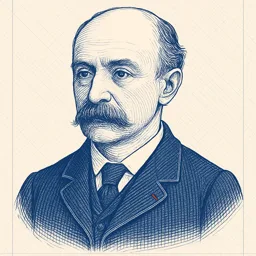
Lord Rayleigh
1842 – 1919
Acoustics, scattering, and the method behind critical-speed estimates.
John William Strutt, third Baron Rayleigh, was a Victorian physicist of extraordinary range: acoustics, wave scattering (why the sky is blue), and the discovery of argon, for which he won the Nobel Prize in 1904.
His method for estimating a system's natural frequency underlies the critical-speed and vibration tools here; his scattering work shaped RF propagation. Few physicists left fingerprints on so many fields.
Portrait: a stylized blueprint-line rendering, not a photograph.
Contributions in the toolbox
- 1876
Dimensionless resistance coefficient (circa).
→ Drag Force - 1877
'Theory of Sound' founds engineering vibration analysis.
→ Natural Frequency (Spring–Mass) - 1879
Formalizes the θ = 1.22·λ/D diffraction resolution criterion.
→ Dawes Angular Resolution - 1879
States the resolution criterion using the first Airy null.
→ Airy Disk Diffraction Radius - 1914
Dimensional analysis (Π-theorem) grounds the flow/head/power coefficients.
→ Pump/Fan Affinity Laws - 1917
Derives the collapse dynamics of a vapor bubble, grounding cavitation theory.
→ Cavitation Number (σ)