
History of the Math
Every formula in the toolbox was somebody's life work. Here they are in order — 1121 milestones and 574 people, from 3000 BCE to 2023, each linked to the calculators that run on their work.
Who derived the formulas, and when — from Archimedes to the new SI.
From the Principia to Artemis — with the Huntsville thread running through it.
Cotton town to Rocket City — Paperclip, Explorer 1, Saturn, the tornadoes, the citizen rocketeers. Our own telling, 27 chapters and counting.
Where this math touches Huntsville
Some of these formulas didn't stay on the page — they flew from here.
The 1807 Line Alabama Still Measures From
Before anybody in Madison County built a rocket, a federal surveyor named Thomas Freeman ran a north-south datum line through the wilderness with chains, transits, and an error budget. Alabama property lines still trace to the Huntsville Meridian two centuries later. How you keep a straight line honest over a hundred miles of karst terrain is a problem the county learned before it had a courthouse...
Read the full story — free for registered readers →One Logarithm, Every Huntsville Rocket
A deaf Russian schoolteacher wrote down one equation in 1903 — delta-v equals exhaust velocity times the log of the mass ratio — and it has governed every vehicle this town ever built. The tyranny of that logarithm is why the V-2 had one stage, Juno I had four, and the Saturn V threw ninety-something percent of itself away to land two men. Run the numbers once and the whole architecture of the Space Age falls out...
Read the full story — free for registered readers →The Missile That Steered Itself
The V-2 flew before digital computers existed, which means its guidance was gyroscopes, analog integrators, and feedback loops closed in hardware. The lineage runs from that LEV-3 platform through Redstone's ST-80 to the Saturn instrument unit built by IBM in Huntsville. How you keep a 46-foot missile pointed the right way with 1944 electronics is a control-theory story with a dark opening chapter...
Read the full story — free for registered readers →The names you keep meeting
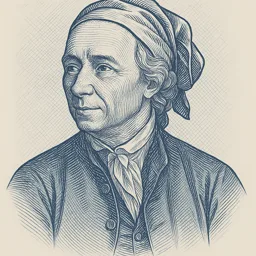
The most prolific mathematician in history; his notation underlies most of engineering.
13 calculators
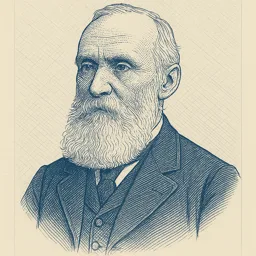
Laid the transatlantic cable's math and an absolute temperature scale carries his name.
12 calculators
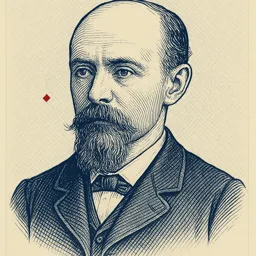
Self-taught telegraph engineer who reformulated Maxwell and gave us operational calculus.
10 calculators
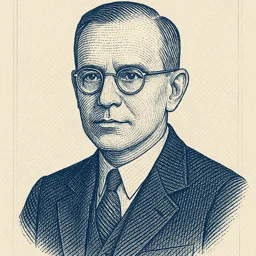
Sampling and thermal-noise theory from Bell Labs.
8 calculators
7 calculators
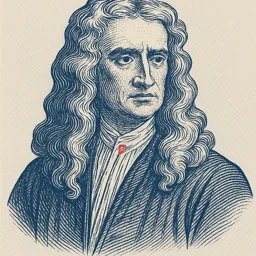
Motion, gravitation, and the calculus — the foundation the rest build on.
7 calculators
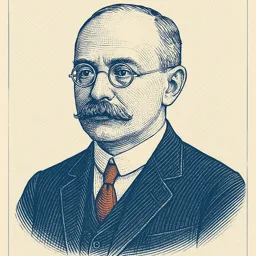
Father of modern aerodynamics; boundary-layer theory is his.
7 calculators
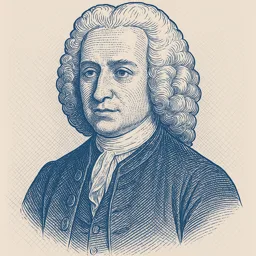
Gave fluid dynamics its founding pressure–velocity relation.
6 calculators
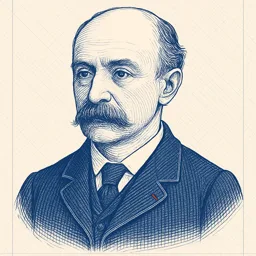
Acoustics, scattering, and the method behind critical-speed estimates.
6 calculators
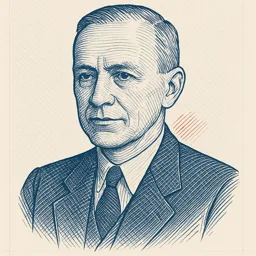
Bell Labs radio engineer; the transmission and noise-figure formulas are his.
6 calculators

Posed the first serious beam-strength problem — brilliantly, and wrongly.
5 calculators
5 calculators
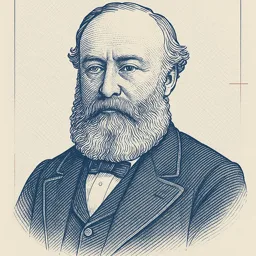
Brewer's son who proved heat is a form of energy; the joule is his.
5 calculators
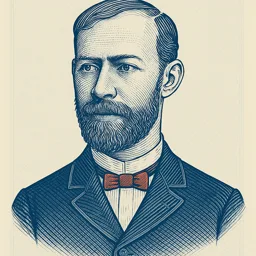
Generated and measured radio waves on a lab bench, proving Maxwell right.
5 calculators
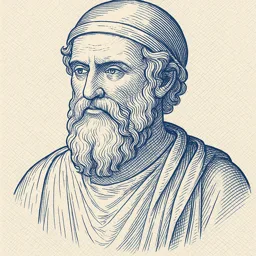
Buoyancy, levers, and the mechanics the ancient world never surpassed.
4 calculators
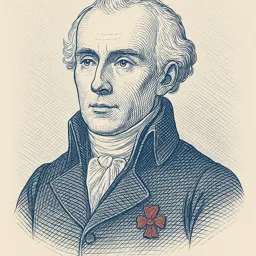
Gave the barometric formula and much of mathematical physics.
4 calculators
4 calculators
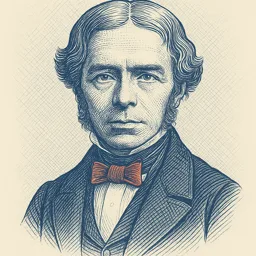
Electromagnetic induction and the groundwork for the field concept.
4 calculators
4 calculators
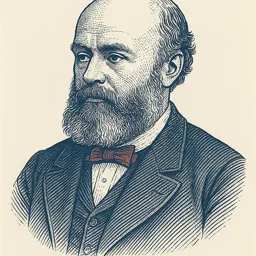
Founding thermodynamicist and soil-mechanics pioneer; a temperature scale bears his name.
4 calculators
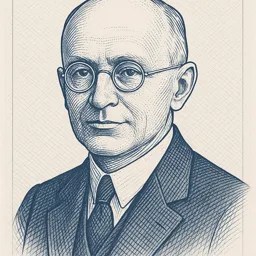
Father of modern engineering mechanics; wrote the textbooks a century used.
4 calculators
4 calculators
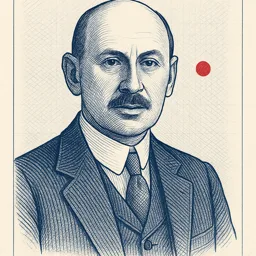
Built and flew the first liquid-fueled rocket.
3 calculators
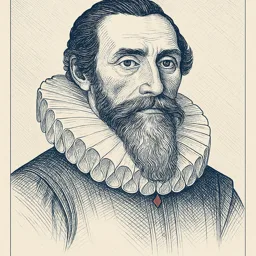
His laws of planetary motion made orbits calculable.
3 calculators
574 people in all — every one has a page. 73 with portraits and bios so far.
The blueprint timeline poster
1121milestones and a dozen illustrated portraits on one 18×24″ blueprint print — from Archimedes to the new SI. Print it for the lab wall.
The timeline
by industry · 1121 milestonesScroll or use +/− to zoom · drag to pan · click a dot for detail. 1073 of 1121 milestones in view.
The full record
Every milestone in order — the same data the timeline above draws from.
3000s BCE
- 3000 BCEMesopotamian potters (circa)
The potter's wheel — inertia smooths intermittent power.
→ Flywheel Kinetic Energy
300s BCE
- 250 BCEArchimedes (circa)
Law of the lever proven from first principles.
→ Lever Mechanical Advantage - 250 BCEArchimedes
Law of the lever — moment as force times arm.
→ Torque Converter - 250 BCEArchimedes
Areas and volumes of curved figures — the segment's ancestry (circa).
→ Horizontal Tank Volume - 250 BCEArchimedes
Volume of the cylinder — the formula, permanently (circa).
→ Vertical Tank Volume
200s BCE
- 140 BCEHipparchus of Nicaea
Chord tables lock in the 360° Babylonian circle.
→ Angle Converter
100s BCE
- 100 BCEGreek artisans (circa)
Antikythera mechanism — geared ratios compute the heavens.
→ Gear Ratio
15th century
- 1493Leonardo da Vinci (circa)
Friction laws found experimentally — and left in notebooks.
→ Friction Force
16th century
- 1500Leonardo da Vinci
Observes the area–velocity trade in channels (circa).
→ Pipe Flow Velocity - 1537Niccolò Tartaglia
'Nova Scientia' — 45° named the range-maximizing elevation.
→ Projectile Range (No Drag) - 1574William Bourne
Chip log described — speed counted in literal knots.
→ Speed Converter
17th century
- 1602Galileo Galilei (circa)
Isochronism of small swings observed.
→ Pendulum Period - 1611Johannes Kepler
Describes real-image formation and the converging-lens telescope in Dioptrice.
→ Thin-Lens Equation + Magnification - 1614John Napier
Publishes the first logarithm tables — the mathematical machinery under every dB.
→ dB Converter - 1614John Napier
Logarithms — the machinery.
→ dB Voltage Ratio - 1614John Napier
Logarithms — arithmetic for multiplicative quantities.
→ Power Sum in dBm - 1615Johannes Kepler
Nova stereometria — wine-barrel gauging done with proto-calculus.
→ Horizontal Tank Volume - 1619Johannes Kepler
Third law: T² ∝ r³.
→ Circular Orbit Velocity & Period - 1628Benedetto Castelli
States Q = A·V — continuity as a law.
→ Pipe Flow Velocity - 1638Galileo Galilei
Poses the cantilever strength problem in Two New Sciences — brilliantly, and wrongly.
→ Beam Deflection - 1638Galileo Galilei
Projectile path proven parabolic.
→ Projectile Range (No Drag) - 1638Galileo Galilei
The cantilever problem posed — beam strength becomes science.
→ Rectangular Section Modulus - 1638Galileo Galilei
Air resistance identified as why falling bodies differ.
→ Terminal Velocity - 1643Evangelista Torricelli
Mercury barometer — pressure measured as a column height.
→ Pressure Converter - 1643Evangelista Torricelli
The barometer — pressure measured as fluid height.
→ Pump Head ⇄ Pressure - 1644Evangelista Torricelli
Efflux law — the √ in the formula.
→ Orifice Flow - 1648Blaise Pascal & Florin Périer
Puy de Dôme experiment proves pressure falls with altitude.
→ Standard Atmosphere - 1648Blaise Pascal & Florin Périer
Puy de Dôme experiment: pressure falls with altitude.
→ Pressure Converter - 1653Blaise Pascal
Pressure transmits equally in a confined fluid.
→ Hydraulic Cylinder Force - 1656Christiaan Huygens
Pendulum clock — timekeeping improves a hundredfold.
→ Pendulum Period - 1662Robert Boyle
P·V constant at fixed temperature.
→ SCFM ⇄ ACFM - 1662Robert Boyle
PV = constant at fixed temperature.
→ Ideal Gas Law (PV = nRT) - 1673Christiaan Huygens
Compound pendulum solved — rotational inertia in practice.
→ Mass Moment of Inertia (Shapes) - 1676Ole Rømer
First demonstration that light has a finite speed, from Jupiter's moons.
→ Frequency ⇄ Wavelength - 1678Robert Hooke
'Ut tensio, sic vis' — the linear spring law published.
→ Coil Spring Rate - 1678Robert Hooke
Linear elasticity — 'ut tensio, sic vis'.
→ Axial Stress & Strain - 1678Robert Hooke
The linear spring — the oscillator's restoring force.
→ Natural Frequency (Spring–Mass) - 1686Gottfried Leibniz
Vis viva — motion's measure proportional to v².
→ Kinetic Energy - 1687Pierre Varignon
Theorem of moments — lever law becomes general statics.
→ Lever Mechanical Advantage - 1687Isaac Newton
Principia adds drag — and takes the parabola away.
→ Projectile Range (No Drag) - 1687Isaac Newton
First theoretical sound speed (air) in the Principia.
→ Speed of Sound in Materials - 1687Isaac Newton
Principia — resistance proportional to V².
→ Drag Force - 1687Isaac Newton
V² drag regime quantified.
→ Terminal Velocity - 1687Isaac Newton
Orbits derived from gravitation; the cannonball argument.
→ Circular Orbit Velocity & Period - 1687Isaac Newton
The cannonball argument defines escape.
→ Escape Velocity - 1687Isaac Newton
Principia embeds moments in the laws of motion.
→ Torque Converter - 1690Joseph Raphson
Publishes the iterative root-finding method later paired with Newton's name.
→ Internal Rate of Return (Newton) - 1694Jacob Bernoulli
Links beam curvature to bending moment.
→ Beam Deflection - 1699Guillaume Amontons
Friction laws published: load-proportional, area-independent.
→ Friction Force
18th century
- 1707Queen Anne statute
231 in³ wine gallon — ancestor of the US gallon.
→ Volumetric Flow Converter - 1707Queen Anne statute
231 in³ wine gallon — still the US gallon.
→ Area & Volume Converter - 1710John Arbuthnot
First recorded sign test, comparing yearly counts of male vs. female births.
→ Sample Median Confidence Interval (Sign-Test / Order Statistic) - 1713Antoine Parent
Neutral axis located correctly.
→ Rectangular Section Modulus - 1714Roger Cotes
Identifies the natural (radian) measure of angle.
→ Angle Converter - 1724Daniel Gabriel Fahrenheit
Reproducible mercury thermometers and the °F scale.
→ Temperature Converter - 1726John Harrison
Gridiron pendulum cancels expansion with brass against steel.
→ Linear Thermal Expansion - 1727J. T. Desaguliers
Early quantified ventilation — air per occupant (circa).
→ Airflow Units (CFM ⇄ m³/h ⇄ L/s) - 1732Henri Pitot
The pitot tube measures flow by its dynamic pressure.
→ Dynamic Pressure (q) - 1733Abraham de Moivre
Derives the normal curve as the limit of the binomial distribution.
→ Normal Distribution Tail Probability - 1738Daniel Bernoulli
Hydrodynamica — ½ρV² enters the pressure budget.
→ Dynamic Pressure (q) - 1738Daniel Bernoulli
Hydrodynamica — the pressure-velocity-height budget.
→ Bernoulli Pressure Change - 1738Daniel Bernoulli
Pressure-to-velocity budget underpinning the meter.
→ Orifice Flow - 1738Daniel Bernoulli
Hydrodynamica — head, velocity, and pressure unified.
→ Pump Head ⇄ Pressure - 1738Daniel Bernoulli
Hydrodynamica establishes the pressure–velocity trade that orifice metering exploits.
→ Orifice β-Ratio Sizing (ISO 5167) - 1740Émilie du Châtelet
'Institutions de Physique' unites theory with the clay-ball experiments.
→ Kinetic Energy - 1742Anders Celsius
Centigrade scale proposed (inverted; flipped by 1745).
→ Temperature Converter - 1744Leonhard Euler
Critical buckling load derived via calculus of variations.
→ Euler Column Buckling - 1744Leonhard Euler
Publishes the elastica — the beam curvature theory under every deflection formula here.
→ Flitch Beam Composite Deflection - 1745von Kleist & van Musschenbroek
The Leyden jar — first capacitor, discovered twice.
→ Capacitor Energy & Charge - 1745Ewald von Kleist / Pieter van Musschenbroek
The Leyden jar — capacitive energy storage.
→ Hold-Up Capacitor Sizing - 1748Leonhard Euler
Circular-function machinery — ω = 2πf.
→ Frequency ⇄ Period - 1748Leonhard Euler
e and the exponential function formalized.
→ RC Charge Time - 1748Leonhard Euler
Formalizes compound-interest and annuity series in Introductio in analysin infinitorum.
→ Loan Amortization Payment - 1750Leonhard Euler & Daniel Bernoulli
The Euler–Bernoulli beam equation — the math under this card.
→ Beam Deflection - 1752Benjamin Franklin
Charge conservation analysis of the jar.
→ Capacitor Energy & Charge - 1754Leonhard Euler
Involute tooth profile analyzed — the modern gear tooth.
→ Gear Ratio - 1754Leonhard Euler
Euler's turbomachine equation.
→ Pump Hydraulic & Shaft Power - 1754Leonhard Euler
Turbomachine equation — pumps deliver head, not pressure (circa).
→ Pump Head ⇄ Pressure - 1756John Smeaton
Hydraulic lime identified for the Eddystone Lighthouse — modern concrete's starting gun.
→ Concrete Slab Volume - 1757Leonhard Euler
Equations of compressible fluid motion.
→ Isentropic Flow Ratios - 1757Leonhard Euler
Continuity embedded in the general flow equations.
→ Pipe Flow Velocity - 1757Leonhard Euler
The equation in its modern form.
→ Bernoulli Pressure Change - 1760Joseph Black
Specific and latent heat distinguished (circa).
→ Heat Exchanger Duty - 1765Leonhard Euler
'Moment of inertia' defined; rigid-body dynamics founded.
→ Mass Moment of Inertia (Shapes) - 1766Jean-Charles de Borda
Vena contracta explains C_d ≈ 0.61.
→ Orifice Flow - 1775Antoine de Chézy
First slope–radius channel formula (circa).
→ Manning Open-Channel Flow - 1776Charles-Augustin de Coulomb
Wedge theory of earth pressure — soil mechanics begins.
→ Rankine Earth Pressure - 1780James Pickard
Crank-and-flywheel patent turns steam strokes into rotation.
→ Flywheel Kinetic Energy - 1781Henry Cavendish
Measures V–I proportionality using shocks to his own body; never publishes.
→ Ohm's Law - 1782Lavoisier & Laplace (circa)
Systematic dilatometer measurements of expansion coefficients.
→ Linear Thermal Expansion - 1782James Watt
Horsepower defined — pumping becomes a priced commodity.
→ Pump Hydraulic & Shaft Power - 1782Pierre-Simon Laplace
Introduces the transform in work on probability — the s-domain is born.
→ Final-Value Theorem — Steady-State Error - 1783James Watt
Defines the horsepower to price steam engines against horses.
→ Shaft Power ⇄ Torque - 1783James Watt
Defines the horsepower to sell steam engines against horses.
→ Power Converter - 1784Charles-Augustin de Coulomb
Torsion of wires quantified — the torsion balance.
→ Shaft Torsion (Solid Round) - 1785Charles-Augustin de Coulomb
Static vs kinetic friction; the engineering model completed.
→ Friction Force - 1787Ernst Chladni
Sound velocities in solids from resonating rods and plates.
→ Speed of Sound in Materials - 1788Joseph-Louis Lagrange
'Mécanique analytique' — virtual work subsumes the lever.
→ Lever Mechanical Advantage - 1789Antoine Lavoisier
Conservation of mass — the bookkeeping behind dilution.
→ Dilution (C₁V₁ = C₂V₂) - 1793French Republic (Delambre & Méchain survey)
Metre defined from the Earth's meridian.
→ Length Converter - 1793French metric commission
Gradian — the right angle decimalized to 100.
→ Angle Converter - 1795Joseph Bramah
Hydraulic press patented — force multiplication by area.
→ Hydraulic Cylinder Force - 1795French Republic
The metre — the metric flow units' ancestor.
→ Airflow Units (CFM ⇄ m³/h ⇄ L/s) - 1795French Republic
Litre defined as the cubic decimeter.
→ Area & Volume Converter - 1796Pierre-Simon Laplace
'Dark stars' — escape velocity meets light speed (circa).
→ Escape Velocity - 1797G. B. Venturi
The converging-diverging meter principle.
→ Bernoulli Pressure Change - 1797André-Jacques Garnerin
First parachute descent from a balloon.
→ Terminal Velocity - 1797Giovanni Battista Venturi
Constricted-tube effect behind flow metering.
→ Volumetric Flow Converter - 1798Count Rumford
Cannon-boring: friction makes heat without limit.
→ Energy Converter - 1799French Academy
Platinum Mètre des Archives deposited.
→ Length Converter - 1799French Academy
Kilogramme des Archives — the kilogram realized.
→ Mass & Force Converter
19th century
- 1800Alessandro Volta
The voltaic pile — the first battery.
→ Battery Life - 1800Alessandro Volta
The pile — cells in series, the first battery.
→ Battery Pack Configuration - 1800Alessandro Volta
Voltaic pile demonstrates dissimilar-metal EMF — and dissolution of the anode.
→ Galvanic Couple Potential - 1800William Herschel
Discovers infrared radiation with a thermometer past the red end of a prism spectrum.
→ IR Seeker Detection Range (NEP) - 1801Textile mill era (circa)
Flat-belt line shafting becomes the standard factory transmission.
→ Belt & Pulley Speed - 1802Gay-Lussac (crediting Charles)
Volume–temperature law.
→ SCFM ⇄ ACFM - 1802Joseph Gay-Lussac
Volume–temperature law published (crediting Charles).
→ Ideal Gas Law (PV = nRT) - 1802John Dalton
Partial pressures and the saturation curve of water vapor.
→ Dew Point & Absolute Humidity - 1804Jean-Baptiste Biot
Early experiments on conduction in bars (circa).
→ Heat Conduction (Fourier) - 1805Pierre-Simon Laplace
The barometric formula — pressure vs. height, mathematically.
→ Standard Atmosphere - 1807Thomas Young
Elastic modulus defined as a material property.
→ Axial Stress & Strain - 1808Jean-Baptiste Biot
Times sound racing through an iron water main vs air.
→ Speed of Sound in Materials - 1809Carl Friedrich Gauss
Formalizes the distribution for measurement error in Theoria Motus.
→ Normal Distribution Tail Probability - 1810Pierre-Simon Laplace
Central limit theorem explains why so many things go normal.
→ Normal Distribution Tail Probability - 1811Amedeo Avogadro
Equal volumes, equal molecules — n enters the equation.
→ Ideal Gas Law (PV = nRT) - 1811Amedeo Avogadro
Molar volume concept — density becomes PM/RT.
→ Gas Density - 1813William Moore
Early derivation of rocket motion — forgotten for a century.
→ Tsiolkovsky Rocket Equation - 1817Henry Kater
Reversible pendulum measures g with precision.
→ Pendulum Period - 1818Augustin-Jean Fresnel
Zone construction in the prize memoir on diffraction.
→ Fresnel Zone Clearance - 1820Thomas Tredgold
'Principles of Carpentry' — section design for practitioners.
→ Rectangular Section Modulus - 1820John McAdam
Macadam road construction — engineered aggregate layers (circa).
→ Aggregate Tonnage - 1820Thomas Tredgold
Elementary Principles of Carpentry rationalizes iron-strengthened timber construction.
→ Flitch Beam Composite Deflection - 1821Gaspard de Prony
Prony brake — the first practical shaft-power dynamometer.
→ Shaft Power ⇄ Torque - 1822Augustin-Louis Cauchy
The stress tensor — stress made rigorous.
→ Axial Stress & Strain - 1822Joseph Fourier
Théorie analytique de la chaleur — heat flow proportional to ΔT.
→ Log-Mean Temperature Difference - 1822Joseph Fourier
Théorie analytique de la chaleur — the law and the series.
→ Heat Conduction (Fourier) - 1822Joseph Fourier
Publishes the conduction law that makes thermal resistances add in series.
→ R-Value / U-Value (Series Wall) - 1822Joseph Fourier
Establishes that periodic signals decompose into harmonic components.
→ FFT Bin Width & Resolution - 1824UK Parliament
Imperial gallon defined — the US/imperial fork is permanent.
→ Volumetric Flow Converter - 1824Joseph Aspdin
Patents Portland cement.
→ Concrete Slab Volume - 1824Joseph Gay-Lussac
Volumetric analysis; the burette and pipette named (circa).
→ Dilution (C₁V₁ = C₂V₂) - 1824Humphry Davy
Fits sacrificial iron/zinc anodes to Royal Navy copper hulls.
→ Galvanic Couple Potential - 1824Sadi Carnot
Establishes the maximum efficiency bound any heat cycle can approach.
→ Rankine Cycle Efficiency (Ideal) - 1824Sadi Carnot
Publishes the reversible-cycle argument that efficiency depends only on reservoir temperatures.
→ Carnot Efficiency Limit - 1824Sadi Carnot
Establishes the temperature-only limit on cycle efficiency — the Carnot COP.
→ Refrigeration Cycle COP - 1824Sadi Carnot
Establishes the reversible-cycle temperature limit on heat-to-work conversion.
→ Heat-Pump COP + Reversible Limit - 1824Sadi Carnot
Analyzes the reversible heat-engine cycle underpinning entropy.
→ Entropy Change (Ideal Gas) - 1826Claude-Louis Navier
Turns beam theory into usable engineering design formulas.
→ Beam Deflection - 1826Claude-Louis Navier
Linear bending theory: σ = M·c/I.
→ Rectangular Section Modulus - 1827Georg Simon Ohm
Publishes Die galvanische Kette — V = IR, to initial ridicule.
→ Ohm's Law - 1827Georg Simon Ohm
V = IR — the law the divider applies twice.
→ Voltage Divider - 1827Georg Simon Ohm
Resistance defined — the quantity being combined.
→ Parallel Resistors - 1827Georg Ohm
Die galvanische Kette — V = IR.
→ Wire Voltage Drop - 1829Gaspard-Gustave de Coriolis
Work defined; the ½mv² form fixed.
→ Kinetic Energy - 1831Michael Faraday
Electromagnetic induction — the transformer's physics.
→ Transformer Turns Ratio - 1832Joseph Henry
Self-induction discovered (the henry remembers him).
→ Inductor Energy - 1833Samuel Hunter Christie
Invents the four-arm bridge circuit.
→ Wheatstone Bridge - 1833Lamé & Clapeyron
Exact thick-cylinder stress solution published.
→ Thin-Wall Pressure Vessel Stress - 1833Michael Faraday
Negative temperature coefficient observed in Ag₂S — the first semiconductor effect.
→ Inrush Limiter (NTC) Sizing - 1833Michael Faraday
Observes the temperature-dependent resistance of silver sulfide — the first recorded thermistor behavior.
→ Thermistor Steinhart-Hart - 1834Louis Poinsot
Geometric picture of free rotation — the inertia ellipsoid.
→ Mass Moment of Inertia (Shapes) - 1834Émile Clapeyron
Combined ideal gas equation PV = nRT.
→ SCFM ⇄ ACFM - 1834Émile Clapeyron
Combines the laws into PV = nRT.
→ Ideal Gas Law (PV = nRT) - 1834Émile Clapeyron
Recasts Carnot's cycle in analytic P–V form, reviving the idea.
→ Carnot Efficiency Limit - 1834Jacob Perkins
Patents a working vapor-compression refrigeration machine.
→ Refrigeration Cycle COP - 1835George Biddell Airy
Describes the diffraction disk that sets the physical resolution limit.
→ Dawes Angular Resolution - 1835George Biddell Airy
Derives the circular-aperture diffraction pattern and its central disk.
→ Airy Disk Diffraction Radius - 1837Michael Faraday
Dielectrics and the measure of capacitance.
→ Capacitor Energy & Charge - 1839Saint-Venant & Wantzel
Derive compressible orifice flow and discover the mass-flow ceiling below the critical pressure ratio.
→ Choked Nozzle (Mach 1 Throat) - 1840Moritz von Jacobi
Maximum power transfer theorem — why matching matters.
→ L-Network Impedance Match - 1840British and American builders
Wrought-iron flitch girders become standard practice for long floor spans.
→ Flitch Beam Composite Deflection - 1841James Prescott Joule
Quantifies electrical heating — the P = VI power relation.
→ Ohm's Law - 1841Royal Society
Awards Ohm the Copley Medal; the law finally sticks.
→ Ohm's Law - 1841James Prescott Joule
I²R heating — the physical meaning of RMS.
→ RMS ⇄ Peak ⇄ Peak-to-Peak - 1841Robert Willis
'Principles of Mechanism' systematizes gear-train kinematics.
→ Gear Ratio - 1841Carl Friedrich Gauss
Formalizes paraxial optics and cardinal points in Dioptrische Untersuchungen.
→ Thin-Lens Equation + Magnification - 1842Christian Doppler
Proposes the frequency shift of moving sources.
→ Doppler Shift - 1842Julius Robert Mayer
States the mechanical equivalent of heat.
→ Energy Converter - 1843Charles Wheatstone
Bakerian Lecture popularizes the bridge (crediting Christie).
→ Wheatstone Bridge - 1843James Prescott Joule
Falling-weight experiments price mechanical energy in heat.
→ Gravitational Potential Energy - 1843James Prescott Joule
Paddle-wheel experiments price heat in work, refined through 1850.
→ Energy Converter - 1843James Prescott Joule
Mechanical equivalent of heat — energy accounting unified.
→ Heat Exchanger Duty - 1844Heinrich Gustav Magnus
The Magnus saturation-vapor-pressure formula.
→ Dew Point & Absolute Humidity - 1845Gustav Kirchhoff
Circuit laws, published at age 21, formalize series-parallel analysis.
→ Voltage Divider - 1845Gustav Kirchhoff
Current law — why parallel conductances add.
→ Parallel Resistors - 1845C.H.D. Buys Ballot
Confirms it with musicians on a moving train.
→ Doppler Shift - 1845Julius Weisbach
Modern head-loss equation with f.
→ Pipe Pressure Drop (Darcy-Weisbach) - 1845Henri Victor Regnault
Precision gas-density measurements (circa).
→ Gas Density - 1845Julius Weisbach
Head-loss equation in the modern f·(L/D)·V²/2g form.
→ Duct Static-Pressure Loss - 1846William Armstrong
Hydraulic crane launches industrial fluid power.
→ Hydraulic Cylinder Force - 1847Hermann von Helmholtz
Conservation of energy stated in full generality.
→ Gravitational Potential Energy - 1848William Thomson (Kelvin)
Absolute thermodynamic temperature scale.
→ Temperature Converter - 1849Eugène Bourdon
Bourdon-tube gauge puts a pressure dial on every boiler.
→ Pressure Converter - 1849Eugène Bourdon
Patents the Bourdon-tube pressure gauge, the basis of dial gauge grading.
→ Pressure-Gauge Accuracy Class → Uncertainty - 1850William Thomson (circa)
The term 'kinetic energy' coined.
→ Kinetic Energy - 1850Rudolf Clausius
Formalizes the energy equation that links thermal and kinetic energy in a flow.
→ Stagnation Temperature (Compressible Flow) - 1851Heinrich Ruhmkorff
Induction coil — stored magnetic energy as a product.
→ Inductor Energy - 1851Léon Foucault
Pendulum demonstrates the Earth's rotation.
→ Pendulum Period - 1851George Gabriel Stokes
Viscous-flow theory — the µ in the denominator.
→ Reynolds Number - 1851John Appold
Curved-vane impeller shows efficiency is design, not luck.
→ Pump Hydraulic & Shaft Power - 1851William Thomson (Lord Kelvin)
Defines the absolute temperature scale that puts T in the efficiency ratio.
→ Carnot Efficiency Limit - 1852William Thomson (Lord Kelvin)
Describes running a heat engine in reverse to heat buildings — the heat pump concept.
→ Heat-Pump COP + Reversible Limit - 1852Edward Ashcroft
Licenses Bourdon's design in the US, spreading the mechanical gauge industry.
→ Pressure-Gauge Accuracy Class → Uncertainty - 1853Lord Kelvin
Predicts LC oscillation mathematically.
→ LC Resonant Frequency - 1853William Rankine
The term 'potential energy' coined.
→ Gravitational Potential Energy - 1853Lord Kelvin
LC oscillation predicted — the reactive tug-of-war.
→ Series RLC Impedance - 1855Lord Kelvin
RC law of the telegraph cable — the time constant's debut.
→ RC Low-Pass Filter - 1855Lord Kelvin
RC transient law from telegraph cable theory.
→ RC Charge Time - 1855Saint-Venant
General torsion theory; circular-section formula's limits mapped.
→ Shaft Torsion (Solid Round) - 1855Peter von Rittinger
Builds an early industrial heat-pump evaporator for salt drying.
→ Heat-Pump COP + Reversible Limit - 1856Lord Kelvin
Discovers resistance changes with strain.
→ Strain Gauge Output - 1857Henry Darcy
Dijon experiments make roughness part of the law.
→ Pipe Pressure Drop (Darcy-Weisbach) - 1857William Rankine
Stress-state earth pressure theory; Ka in closed form.
→ Rankine Earth Pressure - 1857J. R. Brown & Lucian Sharpe
Brown & Sharpe gauge — the geometric series adopted as AWG.
→ Wire Gauge (AWG) Properties - 1857Brown & Sharpe
AWG standardizes the copper in the denominator.
→ Wire Voltage Drop - 1857Henry Darcy
Dijon experiments make wall roughness part of the friction law.
→ Duct Static-Pressure Loss - 1858Luigi Menabrea
Early analysis of pipe-surge pressure (circa).
→ Water Hammer (Joukowsky) - 1858Max von Pettenkofer
Proposes a CO₂ concentration limit — the first quantitative ventilation dilution target.
→ Air Changes Per Hour (ACH ⇄ CFM) - 1858Arthur Cayley
Formalizes matrix algebra and the characteristic equation.
→ 2×2 State-Space Eigenvalues - 1859Gaston Planté
Rechargeable lead-acid cell.
→ Battery Life - 1859Berend Feddersen
Photographs oscillatory spark discharge — theory confirmed.
→ LC Resonant Frequency - 1859William Rankine
Fahrenheit-sized absolute scale for engineering.
→ Temperature Converter - 1859Gaston Planté
Lead-acid rechargeable cell; the 12 V series string to come.
→ Battery Pack Configuration - 1859Gustav Kirchhoff
Defines the blackbody and proves its spectrum is a universal function of temperature alone.
→ Blackbody Radiance (Planck's Law) - 1859W. J. M. Rankine
Publishes the vapor-cycle analysis in his steam-engine manual.
→ Rankine Cycle Efficiency (Ideal) - 1859W. J. M. Rankine
Manual of the Steam Engine treats expansion curves of the form PVⁿ = constant.
→ Compressor Polytropic Work - 1861Lord Kelvin
Double bridge extends null measurement to milliohms.
→ Wheatstone Bridge - 1861Lord Kelvin
Four-terminal (Kelvin) sensing removes lead error.
→ Shunt Resistor - 1865James Clerk Maxwell
Field equations predict EM waves at the speed of light.
→ Frequency ⇄ Wavelength - 1865Sultana boiler explosion
Deadliest US maritime disaster — steam's cost made plain.
→ Thin-Wall Pressure Vessel Stress - 1865Rudolf Clausius
Formalizes entropy, giving the isentropic turbine/pump steps their footing.
→ Rankine Cycle Efficiency (Ideal) - 1865Rudolf Clausius
Introduces entropy, grounding the Carnot bound in the second law.
→ Carnot Efficiency Limit - 1865Rudolf Clausius
Names entropy and formalizes dS = dQ_rev/T.
→ Entropy Change (Ideal Gas) - 1865W. J. M. Rankine
Introduces momentum theory for the marine screw propeller.
→ Propeller Actuator-Disk Thrust - 1867Philippe Gauckler
Proposes the 2/3-power law.
→ Manning Open-Channel Flow - 1867Joseph Monier
Patents wire-reinforced concrete — planters first, structures soon after.
→ Concrete Column Volume - 1867Joseph Monier
Reinforced concrete patented — steel goes into the pour.
→ Rebar Weight - 1867August Wöhler
Publishes systematic rotating-bending fatigue data from railway-axle testing — the first S-N curves.
→ Basquin S-N Fatigue Life - 1867August Wöhler
Rotating-bending axle tests establish the S-N curve and the role of stress amplitude.
→ Goodman Mean-Stress Correction - 1867William Rutter Dawes
Publishes the empirical 4.56"/inch double-star splitting limit.
→ Dawes Angular Resolution - 1868James Clerk Maxwell
'On Governors' launches the analytic study of feedback stability.
→ Damping Ratio → % Overshoot - 1869William Rankine
Whirling speed identified — and supercritical running wrongly forbidden.
→ Shaft Critical Speed (Deflection Method) - 1870William J. M. Rankine
Shock jump conditions from thermodynamics.
→ Normal Shock Relations - 1873James Clerk Maxwell
Field-energy formulation — ½LI² formalized.
→ Inductor Energy - 1873James Thomson
Coins 'radian' at Queen's College Belfast.
→ Angle Converter - 1873Ernst Abbe
Defines numerical aperture and links it to resolution in the microscope.
→ Numerical Aperture ⇄ f/# - 1874Wilhelm Gerber
Fits a parabolic mean-stress relation to Wöhler's data.
→ Goodman Mean-Stress Correction - 1875William H. Johnson
First documents that acid-charged iron loses ductility and recovers after baking.
→ Hydrogen Embrittlement Threshold Stress - 1876Lord Rayleigh
Dimensionless resistance coefficient (circa).
→ Drag Force - 1876Carl von Linde
Builds practical ammonia refrigeration plants, launching industrial cooling.
→ Refrigeration Cycle COP - 1876J. Willard Gibbs
Casts entropy into state-property relations for gases and mixtures.
→ Entropy Change (Ideal Gas) - 1877Lord Rayleigh
'Theory of Sound' founds engineering vibration analysis.
→ Natural Frequency (Spring–Mass) - 1877Charles Renard
Preferred-number series — geometric sizing of standard parts.
→ Nearest E-Series Value - 1878Ernst Abbe / Carl Zeiss
Homogeneous immersion objectives push NA above 1.0 using oil.
→ Numerical Aperture ⇄ f/# - 1879Josef Stefan
Finds total emission scales as T⁴; Boltzmann derives it thermodynamically in 1884.
→ Blackbody Radiance (Planck's Law) - 1879Lord Rayleigh
Formalizes the θ = 1.22·λ/D diffraction resolution criterion.
→ Dawes Angular Resolution - 1879Lord Rayleigh
States the resolution criterion using the first Airy null.
→ Airy Disk Diffraction Radius - 1880Oliver Heaviside
Coaxial cable patented.
→ Coax Loss & Power Out - 1880Oliver Heaviside
Coaxial line patented.
→ Coax Impedance from Dimensions - 1881James Alfred Ewing
Coins 'hysteresis' and maps the B-H loop that stores the loss.
→ Steinmetz Core Loss - 1883Léon Charles Thévenin
Equivalent-circuit theorem — the divider's output impedance.
→ Voltage Divider - 1883Horace Lamb
Skin effect derived for spherical conductors.
→ Skin Depth - 1883Osborne Reynolds
Dye-filament experiment finds the transition criterion.
→ Reynolds Number - 1884Edward Weston
Manganin — the near-zero-tempco resistance alloy.
→ Shunt Resistor - 1884John Henry Poynting
Energy flux of the EM field — S itself.
→ RF Power Density - 1884James Thomson
Coins 'torque' for twisting effort in machinery.
→ Torque Converter - 1884Ernest Ransome
Twisted rebar patent; reinforced concrete becomes buildable in America.
→ Concrete Column Volume - 1884Ernest Ransome
Twisted rebar patent — mechanical bond by geometry.
→ Rebar Weight - 1884Jacobus van 't Hoff
Temperature dependence of equilibrium — the exponential form.
→ Arrhenius Rate Ratio - 1885Oliver Heaviside
Operational circuit analysis normalizes the conductance view.
→ Parallel Resistors - 1885Oliver Heaviside
Operational calculus makes filter math tractable.
→ RC Low-Pass Filter - 1885Oliver Heaviside
Transmission-line theory — reflections quantified.
→ VSWR / Return Loss / Γ - 1885Oliver Heaviside
General conductor case; the effect named and tamed.
→ Skin Depth - 1885Zipernowsky, Bláthy & Déri
Closed-core practical transformer.
→ Transformer Turns Ratio - 1885Karl Benz (circa)
Cone clutch on the first automobiles.
→ Plate Clutch Torque (Uniform Wear) - 1885Municipal building codes
Publish presumptive allowable bearing tables for footing design.
→ Footing Bearing Pressure (Eccentric) - 1886Oliver Heaviside
Names and formalizes inductance; reactive behavior theorized.
→ Reactance (XL / XC) - 1886William Stanley
AC distribution demo at Great Barrington — the grid begins.
→ Transformer Turns Ratio - 1886Oliver Heaviside
Coins 'impedance' for AC opposition.
→ Series RLC Impedance - 1887Heinrich Hertz
Generates and measures radio waves — λf = c confirmed on a lab bench.
→ Frequency ⇄ Wavelength - 1887Oliver Heaviside
Transmission-line theory explains velocity factor in cables.
→ Frequency ⇄ Wavelength - 1887Heinrich Hertz
Resonant circuits generate and detect radio waves.
→ LC Resonant Frequency - 1887Lord Kelvin
AC resistance of practical conductors quantified.
→ Skin Depth - 1887Heinrich Hertz
Measures EM oscillation periods experimentally.
→ Frequency ⇄ Period - 1887Heinrich Hertz
The dipole — the first antenna.
→ Dipole / Whip Length - 1887Pierre-Henri Hugoniot
Independent derivation — the Rankine-Hugoniot relations.
→ Normal Shock Relations - 1887Ernst Mach
Schlieren photograph of a bullet's shock wave.
→ Normal Shock Relations - 1887Ernst Mach
Photographs supersonic shock waves; identifies the speed ratio.
→ Mach Number from Airspeed & Altitude - 1887Clemens Herschel
Commercial venturi meter for waterworks.
→ Bernoulli Pressure Change - 1887Clemens Herschel
Commercial venturi meter — flow becomes a billable number.
→ Volumetric Flow Converter - 1887Ernst Mach
Photographs shock waves; the sonic ratio gets its physics.
→ Speed Converter - 1887Svante Arrhenius
Ionic dissociation theory — concentration becomes physical chemistry.
→ Dilution (C₁V₁ = C₂V₂) - 1887Heinrich Hertz
The dipole — radio's first and reference antenna.
→ ERP ⇄ EIRP - 1887Cesare Cipoletti
Develops the 1:4 trapezoidal weir to eliminate end-contraction correction.
→ Cipoletti Weir Flow - 1887Gustav Zeuner
Coins 'polytropic' in Technische Thermodynamik, unifying isothermal and adiabatic as special cases.
→ Compressor Polytropic Work - 1887Hugh L. Callendar
Establishes the platinum resistance thermometer and its quadratic R–t fit.
→ Pt100 RTD (Callendar–Van Dusen) - 1888Gustaf de Laval
The converging–diverging nozzle goes supersonic.
→ Isentropic Flow Ratios - 1888Gustaf de Laval
Adds the diverging section — the convergent-divergent nozzle — to drive steam turbines supersonic.
→ Choked Nozzle (Mach 1 Throat) - 1889British Association
The watt adopted as the unit of power, honoring Watt.
→ Shaft Power ⇄ Torque - 1889Friedrich Engesser
Tangent-modulus theory extends buckling past the elastic range.
→ Euler Column Buckling - 1889Gustaf de Laval
Runs turbine shafts above critical on flexible spindles.
→ Shaft Critical Speed (Deflection Method) - 1889Robert Manning
Presents the formula that takes his name.
→ Manning Open-Channel Flow - 1889British Association
The joule named in Joule's honor.
→ Energy Converter - 1889British Association
The watt named as the unit of power.
→ Power Converter - 1889Svante Arrhenius
Activation energy and the rate equation.
→ Arrhenius Rate Ratio - 1889R. E. Froude
Refines the actuator-disk model; induced velocity splits half fore and half aft.
→ Propeller Actuator-Disk Thrust - 1891G. H. Bryan
First energy solution for buckling of a simply supported plate in compression.
→ Plate Critical Buckling Stress - 1892J. A. Fleming
AC instrument era forces peak-vs-RMS bookkeeping.
→ Crest Factor - 1892François Hennebique
Monolithic reinforced-concrete frame system — column, beam, and slab as one.
→ Concrete Column Volume - 1892Oliver Heaviside
Operational calculus for circuit transients; the value theorems in embryonic form.
→ Final-Value Theorem — Steady-State Error - 1892Charles P. Steinmetz
Publishes 'On the Law of Hysteresis' — loss per cycle ∝ B^1.6.
→ Steinmetz Core Loss - 1892General Electric
Acquires Eickemeyer's firm to bring Steinmetz and his hysteresis work in-house.
→ Steinmetz Core Loss - 1893Charles Steinmetz
Complex/phasor method tames AC calculation.
→ RMS ⇄ Peak ⇄ Peak-to-Peak - 1893Edward Weston
Portable precision instruments make shunt measurement standard practice.
→ Shunt Resistor - 1893Charles Steinmetz
Complex phasor method — reactance becomes arithmetic.
→ Reactance (XL / XC) - 1893T. C. Mendenhall
US customary units legally defined from the meter.
→ Length Converter - 1893Arthur Kennelly
'Impedance' paper — complex Z formalized.
→ Series RLC Impedance - 1893Charles Steinmetz
Phasor method makes RLC arithmetic routine.
→ Series RLC Impedance - 1893Wilhelm Wien
Displacement law — λ_peak·T is constant, the 2898 µm·K rule.
→ Blackbody Radiance (Planck's Law) - 1894Stanley Dunkerley
Empirical formula for critical speeds of loaded shafts.
→ Shaft Critical Speed (Deflection Method) - 1894Rayleigh & Ramsay
Argon discovered from a 0.5% density anomaly.
→ Gas Density - 1895ASH&VE (ASHRAE predecessor)
Founded, formalizing heating and ventilating engineering practice in the US.
→ Air Changes Per Hour (ACH ⇄ CFM) - 1895Charles Parsons
Builds the first cavitation tunnel to study propeller bubble collapse on Turbinia.
→ Cavitation Number (σ) - 1896Niagara Falls plant
AC power transmission wins; RMS becomes the lingua franca.
→ RMS ⇄ Peak ⇄ Peak-to-Peak - 1896Charles-Édouard Guillaume
Invar discovered — near-zero expansion alloy.
→ Linear Thermal Expansion - 1896Henri Becquerel
Radioactivity discovered in uranium salts.
→ Half-Life Decay - 1896Wilhelm Wien
Publishes the radiation distribution law that yields the exponential band approximation.
→ Pyrometer Emissivity Correction - 1897Wilhelm Peukert
Capacity vs. discharge-rate law.
→ Battery Life - 1897Oliver Lodge
Patents syntonic (tuned) wireless telegraphy.
→ LC Resonant Frequency - 1897Charles Parsons / Turbinia
Propeller cavitation discovered at sea; first cavitation tunnel.
→ NPSH Available - 1897National Electrical Code
First NEC — wire size becomes a safety regulation, circa.
→ Wire Gauge (AWG) Properties - 1897National Electrical Code
First NEC; drop guidance enters wiring practice, circa.
→ Wire Voltage Drop - 1898Nikolai Joukowsky
ΔP = ρ·a·Δv established on Moscow's mains.
→ Water Hammer (Joukowsky) - 1898S. B. Russell
Proposes measuring impact energy of metals with a swinging pendulum.
→ Charpy V-Notch Impact Energy - 1898Julius von Hann
Cosine-bell smoothing later formalized as the Hann window.
→ Window Amplitude & Scallop Loss - 1899John Goodman
Publishes the linear σₐ–σₘ trade-off in Mechanics Applied to Engineering.
→ Goodman Mean-Stress Correction
20th century
- 1900Harmon S. Palmer
Patents the hollow-block molding machine — the CMU is born.
→ Concrete Block Wall - 1900Johan August Brinell
Demonstrates the ball-indentation hardness test at the Paris Exposition.
→ Hardness Conversion (HRC / HV / HB) - 1900Max Planck
Presents the quantized radiation law that fits Rubens and Kurlbaum's cavity data at all wavelengths.
→ Blackbody Radiance (Planck's Law) - 1900Karl Pearson
Publishes the χ² goodness-of-fit test in the Philosophical Magazine.
→ χ² Goodness-of-Fit - 1900Photographic industry
f-stop scale standardized in √2 steps for exposure control.
→ Numerical Aperture ⇄ f/# - 1901Guglielmo Marconi
Transatlantic radio makes path loss an engineering question.
→ Free-Space Path Loss - 1901Guglielmo Marconi
Over-the-horizon mystery starts propagation science.
→ Radio / Radar Horizon - 1901Wilbur & Orville Wright
Wind-tunnel lift measurements replace bad tables.
→ Lift Force - 19013rd CGPM
Mass vs weight separated; g₀ = 9.80665 m/s² fixed.
→ Mass & Force Converter - 19013rd CGPM
Litre tied to 1 kg of water — off by 28 ppm.
→ Area & Volume Converter - 1901Georges Charpy
Standardizes the notched-bar pendulum test — specimen, anvil, and energy bookkeeping.
→ Charpy V-Notch Impact Energy - 1901Max Planck
Full spectral radiance law — the exact parent of the Wien approximation.
→ Pyrometer Emissivity Correction - 1901L. Holborn & F. Kurlbaum
Build the practical optical (disappearing-filament) pyrometer.
→ Pyrometer Emissivity Correction - 1902Léon Teisserenc de Bort
Balloon soundings discover the tropopause and stratosphere.
→ Standard Atmosphere - 1902Richard Stribeck
Systematic ball-bearing load-capacity experiments.
→ Bearing L10 Life - 1902Wilhelm Kutta
Circulation condition at the trailing edge.
→ Lift Force - 1902Lorenzo Allievi
General theory of hydraulic transients.
→ Water Hammer (Joukowsky) - 1902Rutherford & Soddy
Exponential decay law and transmutation theory — the half-life.
→ Half-Life Decay - 1903Aurel Stodola
Measures pressure along a Laval nozzle — theory confirmed (circa).
→ Isentropic Flow Ratios - 1903Konstantin Tsiolkovsky
The rocket equation published, with liquid fuel proposed.
→ Tsiolkovsky Rocket Equation - 1903Konstantin Tsiolkovsky
11.2 km/s framed as spaceflight's price of exit.
→ Escape Velocity - 1903Konstantin Tsiolkovsky
Exhaust velocity identified as rocketry's key metric.
→ Specific Impulse - 1903US refrigeration industry
Ton of refrigeration standardized from melting ice.
→ Power Converter - 1903Aurel Stodola
Publishes nozzle pressure traverses experimentally confirming the sonic throat.
→ Choked Nozzle (Mach 1 Throat) - 1903Wright Brothers
Trim the Flyer with movable ballast, an early CG-management practice.
→ CG Shift from Fuel Burn - 1903Ludwig Prandtl
Founds modern compressible aerodynamics, making stagnation properties practical design quantities.
→ Stagnation Temperature (Compressible Flow) - 1904Ludwig Prandtl
Göttingen program makes supersonic flow an engineering science.
→ Oblique Shock (θ-β-M) - 1904Ludwig Prandtl
Force coefficients normalized by q — modern aerodynamic bookkeeping (circa).
→ Dynamic Pressure (q) - 1904Ludwig Prandtl
Boundary-layer theory explains why Re governs.
→ Reynolds Number - 1904Ludwig Prandtl
Boundary layer explains where drag comes from.
→ Drag Force - 1904Herman Besser
Block-making machinery industrializes; blocks become a commodity.
→ Concrete Block Wall - 1904Christian Hülsmeyer
Patents the telemobiloscope — first radio echo detection of ships.
→ Radar Range Equation - 1904John Ambrose Fleming
Patents the thermionic diode valve — the first reliable AM rectifier.
→ Envelope Detector RC Constant - 1904David Hilbert
Coins 'eigenvalue' in his theory of integral equations.
→ 2×2 State-Space Eigenvalues - 1905H. S. Hele-Shaw (circa)
Multi-plate oil-bath clutch developed.
→ Plate Clutch Torque (Uniform Wear) - 1906Nikolai Joukowsky
Lift = ρVΓ — the circulation theorem.
→ Lift Force - 1906Andrey Markov
Introduces Markov chains — the two-state up/down model behind steady-state availability.
→ Availability (MTBF / MTTR) - 1906Greenleaf Whittier Pickard
Silicon cat's-whisker crystal detector puts envelope detection in every crystal set.
→ Envelope Detector RC Constant - 1907H. J. Round
First observation of electroluminescence (SiC).
→ LED Series Resistor - 1907Oscar Kjellberg
Coated stick electrode makes structural arc welds possible.
→ Fillet Weld Throat Stress - 1907Fuller & Thompson
Ideal aggregate gradation curve published.
→ Aggregate Tonnage - 1907H. J. Round
Electroluminescence observed in silicon carbide.
→ LED Array / String Designer - 1908Theodor Meyer
Oblique-shock θ-β-M theory in his dissertation under Prandtl.
→ Oblique Shock (θ-β-M) - 1908Arnold Sommerfeld
Coins the name 'Reynolds number'.
→ Reynolds Number - 1908William Sealy Gosset ('Student')
Publishes the distribution of the sample mean, groundwork for interval estimation.
→ Sample Size for a Mean (Known σ) - 1908William Sealy Gosset (Student)
Small-sample theory that underpins confidence-based sizing.
→ Sample Size (Binomial Proportion) - 1908W. S. Gosset ('Student')
Publishes the t-distribution for small-sample inference, writing under a pseudonym for Guinness.
→ Student-t Mean Confidence Interval - 1908William Gosset ('Student')
Publishes the t-distribution — the reason small-n uncertainties need k > 2.
→ Type A / Type B Combined Uncertainty - 1908Italian post-Messina commission
First codified lateral-force coefficient for earthquake design.
→ Seismic Base Shear (ASCE 7 ELF) - 1909George Stoney
Relates film stress to substrate curvature — the first bonded-layer stress formula.
→ CTE Mismatch Thermal Stress - 1909A. K. Erlang
Publishes the first queueing analysis of telephone traffic congestion.
→ M/M/1 Queue - 1909A. K. Erlang
Lays the groundwork for traffic intensity in telephone trunk sizing.
→ Utilization Law (ρ = λS) - 1910O. H. Basquin
Shows S-N data is linear on log-log axes and fits the power law this card evaluates.
→ Basquin S-N Fatigue Life - 1910E. N. da C. Andrade
First systematic characterization of creep as a time-dependent flow law in metals.
→ Larson-Miller Creep Life - 1910Stephen Timoshenko
Tabulates buckling coefficients k for practical edge conditions and load cases.
→ Plate Critical Buckling Stress - 1911ASTM
A15 standardizes reinforcing bars; the numbered size system follows.
→ Rebar Weight - 1911Willis Carrier
Rational psychrometric formulae — air conditioning gets its chart.
→ Dew Point & Absolute Humidity - 1911Frederick W. Taylor
Scientific management puts machine-time accounting on the shop floor.
→ Machine Utilization & Availability - 1911Thomas Weymouth
Standardizes orifice-plate flow measurement, whose square-law DP inherently limits turndown.
→ Flow-Meter Turndown Ratio - 1912Gustave Eiffel
Wind-tunnel C_d measurements; the drag crisis found.
→ Drag Force - 1913Baltimore ready-mix pioneers
First ready-mixed concrete delivered — the cubic yard becomes a commodity.
→ Concrete Slab Volume - 1913IEC
International Annealed Copper Standard fixes ρ = 1.7241 µΩ·cm.
→ Wire Gauge (AWG) Properties - 1913Henry Ford
Moving assembly line makes equal-time task allocation an economic necessity.
→ Line Balancing Efficiency - 1913Ford W. Harris
Publishes the original square-root lot-size derivation in a trade magazine.
→ Economic Order Quantity (EOQ) - 1914Kenneth S. Johnson
Coins Q for coil quality at Western Electric (published usage 1920s).
→ Q Factor ⇄ Bandwidth - 1914ASME
Boiler & Pressure Vessel Code — hoop stress becomes law.
→ Thin-Wall Pressure Vessel Stress - 1914Stanley P. & Hugh M. Rockwell
Patent the differential-depth tester for rapid bearing-race checks.
→ Hardness Conversion (HRC / HV / HB) - 1914Lord Rayleigh / Edgar Buckingham
Dimensional analysis (Π-theorem) grounds the flow/head/power coefficients.
→ Pump/Fan Affinity Laws - 1915Compressed Air Institute era
Industry standard reference conditions emerge (circa).
→ SCFM ⇄ ACFM - 1915Wilhelm Nusselt
Convective heat-transfer theory; LMTD framework matures (circa 1910s).
→ Log-Mean Temperature Difference - 1915Bertram Hopkinson
States cube-root blast scaling; Cranz reaches the same law independently.
→ Blast Overpressure at Range (Hopkinson-Cranz) - 1915Bertram Hopkinson
States cube-root blast scaling law from wartime charge tests.
→ TNT-Equivalent Blast Range - 1915E. T. Whittaker
Introduces the cardinal (sinc) interpolation series.
→ Sinc Interpolation Error - 1917John Gates
Rubber V-belt invented — the compact machine drive.
→ Belt & Pulley Speed - 1917Hydraulic Institute
Pump test standards make efficiency claims comparable.
→ Pump Hydraulic & Shaft Power - 1917Hydraulic Institute
Standards body that codified NPSH practice.
→ NPSH Available - 1917B. P. Haigh
Introduces the constant-life (Haigh) diagram for plotting mean-stress criteria.
→ Goodman Mean-Stress Correction - 1917Theodore Case
Develops the thallous sulfide photoconductor — the first practical IR detector cell.
→ IR Seeker Detection Range (NEP) - 1917Lord Rayleigh
Derives the collapse dynamics of a vapor bubble, grounding cavitation theory.
→ Cavitation Number (σ) - 1918Conrad Bahr
Torque wrench invented for NYC water-main flange bolts.
→ Bolt Torque from Preload - 1918Ludwig Prandtl
Lifting-line theory — finite wings computed.
→ Lift Force - 1918Conrad Bahr
Torque wrench patented — tightening becomes a number.
→ Torque Converter - 1918Duff Abrams
Water–cement ratio law; aggregate science enters mix design.
→ Aggregate Tonnage - 1918R. A. Fisher
Coins the term 'variance' and its partitioning in his paper on Mendelian inheritance.
→ One-Way ANOVA F-Statistic - 1918Edwin Armstrong
Superheterodyne fixes detection at a known IF, making the RC a real design number.
→ Envelope Detector RC Constant - 1918Ludwig Prandtl
Lifting-line theory derives induced drag from trailing vortices.
→ Oswald-Efficiency Induced Drag - 1919Henry Jeffcott
Whirling rotor theory — self-centering above resonance explained.
→ Shaft Critical Speed (Deflection Method) - 1919Leslie Irvin
First premeditated free-fall parachute jump — V_t survived by design.
→ Terminal Velocity - 1919Robert Goddard
'A Method of Reaching Extreme Altitudes' — measured nozzle efficiency.
→ Specific Impulse - 1919Henri Abraham & Eugène Bloch
The multivibrator — two-state RC timing circuits.
→ 555 Timer — Astable - 1919Henri Abraham & Eugène Bloch
Multivibrator circuits, including the one-shot.
→ 555 Timer — Monostable - 1920George Campbell / Bell System
Image-parameter network design matures.
→ Pi Attenuator - 1920George Campbell
Two-port image design formalized.
→ T Attenuator - 1920Charles-Édouard Guillaume
Nobel Prize for Invar and precision metrology.
→ Linear Thermal Expansion - 1920George Campbell / Bell System
Image-parameter design; matching becomes systematic.
→ L-Network Impedance Match - 1920A. A. Griffith
Energy-balance theory of brittle fracture from flaws in glass.
→ Fracture Toughness — Critical Stress / Crack Size - 1920Albert Betz
Derives the ideal actuator-disk power limit for extracting/adding energy to a stream.
→ Propeller Actuator-Disk Thrust - 1920ASME
Begins standardizing gauge dimensions and accuracy under the B40 committee.
→ Pressure-Gauge Accuracy Class → Uncertainty - 1921R. L. Smith & G. E. Sandland (Vickers Ltd.)
Introduce the diamond-pyramid (Vickers) test spanning soft to hardened metals.
→ Hardness Conversion (HRC / HV / HB) - 1922Ronald A. Fisher
Corrects the degrees-of-freedom rule for estimated parameters.
→ χ² Goodness-of-Fit - 1922Nicolas Minorsky
Formulates three-term (PID) control while analyzing ship steering.
→ Ziegler-Nichols PID Tuning - 1923Otto Zobel
Systematic matched-network (pad/filter) synthesis.
→ Pi Attenuator - 1923Otto Zobel
Pad synthesis equations in modern form.
→ T Attenuator - 1923Albert Strickler
Roughness coefficient tied to physical wall texture.
→ Manning Open-Channel Flow - 1923Hermann Oberth
'Die Rakete zu den Planetenräumen' — the German school begins.
→ Tsiolkovsky Rocket Equation - 1923Hermann Oberth
The book that made orbital mechanics a movement.
→ Hohmann Transfer - 1924Bell System engineers
Define the Transmission Unit (TU), replacing 'miles of standard cable' with a clean log ratio.
→ dB Converter - 1924ICAN
First international standard atmosphere for aviation.
→ Standard Atmosphere - 1924Arvid Palmgren
Load–life exponent and statistical bearing life at SKF.
→ Bearing L10 Life - 1924ICAN
Standard atmosphere fixes T(h) — Mach from altitude becomes arithmetic.
→ Mach Number from Airspeed & Altitude - 1924Dietrich Thoma
Cavitation similarity number σ (circa).
→ NPSH Available - 1924Bell System
Transmission Unit replaces miles-of-standard-cable.
→ Power Sum in dBm - 1924Harry Nyquist
Relates signaling rate to bandwidth, seeding the capacity idea.
→ Shannon-Hartley Channel Capacity - 1924Walter Shewhart
Invents the control chart, defining process spread as ±3σ.
→ Cp / Cpk Process Capability - 1924Arvid Palmgren (SKF)
Rates bearings by 90%-survival life — the original B10/L10.
→ Weibull B10 Life (β, η) - 1924Walter A. Shewhart
Sketches the first control chart in a one-page Western Electric memo.
→ X̄ / R Control Chart Limits - 1925Borg & Beck (circa)
Single dry-plate clutch standardizes the modern form.
→ Plate Clutch Torque (Uniform Wear) - 1925Walter Hohmann
Proves the minimum-energy two-impulse transfer.
→ Hohmann Transfer - 1925Karl Terzaghi
Erdbaumechanik — modern soil mechanics, effective stress, and the limits of the classics.
→ Rankine Earth Pressure - 1925Stephen Timoshenko
Bimetal thermostat analysis: two bonded strips bending under ΔT.
→ CTE Mismatch Thermal Stress - 1925Frederick Merkel
Publishes the enthalpy-potential theory of evaporative cooling that underlies tower performance analysis.
→ Cooling Tower Approach & Range - 1925R. A. Fisher
Publishes Statistical Methods for Research Workers — ANOVA for experimenters.
→ One-Way ANOVA F-Statistic - 1925Ronald A. Fisher
Formalizes degrees of freedom and popularizes the t-test in Statistical Methods for Research Workers.
→ Student-t Mean Confidence Interval - 1925M. S. Van Dusen
Adds the cubic term extending the fit below 0 °C.
→ Pt100 RTD (Callendar–Van Dusen) - 1926ARRL handbook era
468/f enters amateur canon.
→ Dipole / Whip Length - 1926Robert Goddard
First liquid-fuel rocket flight, Auburn, Massachusetts.
→ Tsiolkovsky Rocket Equation - 1926Robert Goddard
First liquid-fuel flight — Isp leaves the test stand.
→ Specific Impulse - 1926Carl Cranz
Independently derives the same scaling — hence Hopkinson-Cranz.
→ TNT-Equivalent Blast Range - 1926Robert Goddard
Flies a de Laval nozzle on the first liquid-fueled rocket.
→ Choked Nozzle (Mach 1 Throat) - 1926Hermann Glauert
Unifies momentum and blade-element theory for aircraft airscrews.
→ Propeller Actuator-Disk Thrust - 1926U.S. Air Commerce Act
Introduces loading and balance requirements into airworthiness rules.
→ CG Shift from Fuel Burn - 1926Robert H. Goddard
First liquid-propellant rocket flight — gasoline and LOX proportioned by hand.
→ Bipropellant O/F Ratio - 1927Harold Black
Negative feedback, sketched on a ferry-ride newspaper.
→ Op-Amp Gain - 1927Maurice Fréchet
Describes the extreme-value form underlying the distribution.
→ Weibull Reliability R(t) - 1928Bell System / W. H. Martin
TU renamed the decibel, honoring Alexander Graham Bell.
→ dB Converter - 1928Radio Manufacturers Association
Standardizes the resistor color code.
→ Resistor Color Code - 1928Harry Nyquist
Sampling rate theorem groundwork.
→ ADC Resolution - 1928Bell System
Decibel adopted; the 10·log/20·log power-voltage pair standardizes.
→ dB Voltage Ratio - 1928John B. Johnson
Measures thermal noise in resistors.
→ Thermal Noise Floor - 1928Harry Nyquist
Derives kTB from thermodynamics.
→ Thermal Noise Floor - 1928Warren Marrison
Quartz crystal clock — Q as a timekeeping technology.
→ Q Factor ⇄ Bandwidth - 1928American Welding Society
First structural welding code — throat stress made law.
→ Fillet Weld Throat Stress - 1928Stepan Timoshenko
'Vibration Problems in Engineering' — the working handbook.
→ Natural Frequency (Spring–Mass) - 1928Bell System
The TU renamed the decibel.
→ Power Sum in dBm - 1928Ralph Hartley
Defines information logarithmically and links it to bandwidth.
→ Shannon-Hartley Channel Capacity - 1928Harold Dodge & Harry Romig
Develop acceptance sampling and LTPD tables at Bell Labs.
→ Attribute-Data Sample Size - 1928Harry Nyquist
Relates signaling rate to bandwidth in telegraph transmission.
→ Nyquist Rate & Aliasing - 1928Harry Nyquist
Fixes the sampling limit at half the sample rate — the top bin of any FFT.
→ FFT Bin Width & Resolution - 1928Harry Nyquist
Shows telegraph channels need ≥2 samples per cycle of the highest frequency — the Nyquist rate.
→ Anti-Alias Filter Attenuation - 1929Espenschied & Affel
Broadband coax system — the modern cable.
→ Coax Loss & Power Out - 1929A. M. Wahl
Curvature correction factor for helical spring stress.
→ Coil Spring Rate - 1929Jakob Ackeret
Names the Mach number.
→ Mach Number from Airspeed & Altitude - 1929Monaco Hydrographic Conference / Jakob Ackeret
Nautical mile fixed at 1852 m; 'Mach number' named.
→ Speed Converter - 1929Espenschied & Affel (Bell)
Broadband coaxial transmission system.
→ Coax Impedance from Dimensions - 1929U.S. Bureau of Reclamation
Publishes calibrated Cipoletti coefficients for irrigation delivery.
→ Cipoletti Weir Flow - 1930Stephen Butterworth
Maximally flat filter paper starts modern filter design.
→ RC Low-Pass Filter - 1930Stepan Timoshenko
'Strength of Materials' canonizes modern practice.
→ Axial Stress & Strain - 1930Stepan Timoshenko (circa)
Torsion design practice standardized in the classic texts.
→ Shaft Torsion (Solid Round) - 1930German aircraft industry
Uses Takt as the interval for advancing airframes through assembly.
→ Takt Time - 1930Instrumentation practice
Zero-and-span adjustment established as the standard two-knob calibration for analog meters and bridges.
→ DAQ Offset + Gain Error - 1930Stephen Butterworth
Publishes the maximally-flat amplifier filter response in Experimental Wireless.
→ Butterworth Filter Order - 1930Norbert Wiener
Formalizes autocorrelation and its link to the power spectrum.
→ Cross-Correlation Peak Lag - 1930Irving Fisher
The Theory of Interest formalizes present value and the rate of return.
→ Net Present Value (Uniform Cash Flow) - 1930Eugene L. Grant
Principles of Engineering Economy establishes interest-factor methods for engineers.
→ Net Present Value (Uniform Cash Flow) - 1930Industrial cost analysts
Payback ratio adopted as a rule-of-thumb capital screen in manufacturing.
→ Simple Payback Period - 1930Eugene L. Grant
Principles of Engineering Economy establishes the discrete factor notation for engineers.
→ Loan Amortization Payment - 1930Samuel Ruben
Patents practical metal-oxide NTC thermistor elements.
→ Thermistor Steinhart-Hart - 1930AGA / ASME
Large calibration campaigns fix discharge coefficients for square-edged plates.
→ Orifice β-Ratio Sizing (ISO 5167) - 1931ASTM
C90 standardizes load-bearing CMU dimensions and strength.
→ Concrete Block Wall - 1931André Clavier (ITT/LCT)
First commercial microwave link, Calais–Dover — clearance becomes engineering.
→ Fresnel Zone Clearance - 1931Walter A. Shewhart
Publishes Economic Control of Quality, founding statistical process control.
→ X̄ / R Control Chart Limits - 1931Walter Shewhart
Establishes statistical control theory underpinning measurement variation analysis.
→ Gage R&R (%P/T) - 1931Stephen Butterworth
Publishes the maximally-flat filter response, A = 10·log₁₀(1 + (f/fc)^2N).
→ Anti-Alias Filter Attenuation - 1931Wilhelm Cauer
Develops the elliptic filter, framing Butterworth's design within general approximation theory.
→ Butterworth Filter Order - 1932Frederick Terman
Radio Engineering spreads the quantitative treatment of detector distortion.
→ Envelope Detector RC Constant - 1932Harry Nyquist
Publishes the encirclement stability criterion around the −1 point.
→ Phase & Gain Margin - 1932Harry Nyquist
Stability criterion that made frequency-domain loop shaping possible.
→ Lead / Lag Compensator Design - 1932Theodore von Kármán
Effective-width concept — plates carry load beyond σ_cr.
→ Plate Critical Buckling Stress - 1933Schelleng, Burrows & Ferrell
Effective-earth-radius (4/3) refraction model.
→ Radio / Radar Horizon - 1933NACA
Systematic airfoil families catalogue C_L for designers.
→ Lift Force - 1933ASTM
First issues E23, the standard test method for notched-bar impact testing of metallic materials.
→ Charpy V-Notch Impact Energy - 1933Rosin & Rammler
Apply the same function to particle-size distributions.
→ Weibull Reliability R(t) - 1933Vladimir Kotelnikov
States the sampling theorem independently in the USSR.
→ Nyquist Rate & Aliasing - 1933Johann Nikuradse
Sand-grain roughness experiments at Göttingen map the turbulent friction regimes.
→ Moody Friction Factor (Colebrook) - 1933W. Bailey Oswald
NACA Report 408 introduces the airplane efficiency factor e.
→ Oswald-Efficiency Induced Drag - 1933California legislature / UBC
Long Beach earthquake makes seismic base shear mandatory via the Riley Act.
→ Seismic Base Shear (ASCE 7 ELF) - 1934CISPR founded
Interference measurement standardizes on field-strength/µV language.
→ dBm ⇄ dBµV (50 Ω) - 1934Jacob den Hartog
'Mechanical Vibrations' and the tuned damper canon.
→ Natural Frequency (Spring–Mass) - 1934Clarence Zener
Quantum-tunneling theory of electrical breakdown in solids.
→ Zener Shunt Regulator - 1934FCC
US licensing regime; ERP becomes broadcast's yardstick.
→ ERP ⇄ EIRP - 1934R. H. Wilson
Popularizes the formula in practice — hence 'Wilson EOQ'.
→ Economic Order Quantity (EOQ) - 1934Mollier / steam-table lineage
h–s diagrams and standardized steam tables make state-point lookup routine.
→ Rankine Cycle Efficiency (Ideal) - 1934Jerzy Neyman
Formalizes confidence intervals, giving E and z their meaning.
→ Sample Size (Binomial Proportion) - 1934George Snedecor
Tabulates the variance ratio directly and names the F distribution for Fisher.
→ One-Way ANOVA F-Statistic - 1934C. Batho & E. H. Bateman
Report to the UK Steel Structures Research Committee that high-strength bolts can develop clamping force equal to rivets.
→ Bolt Shear (Lap Joint) - 1935Henry Eyring
Transition-state theory explains the barrier.
→ Arrhenius Rate Ratio - 1935Robert Watson-Watt
Daventry experiment proves aircraft detection by radio; British radar program launches.
→ Radar Range Equation - 1935R. A. Fisher
The Design of Experiments formalizes randomization and replication behind the F test.
→ One-Way ANOVA F-Statistic - 1935Kenneth Boulding
Gives a formal statement of the internal rate of return.
→ Internal Rate of Return (Newton) - 1935Volta Congress / Adolf Busemann
Introduces wing sweep as a means to delay compressibility drag rise.
→ Drag Divergence Mach Number - 1935Hermann Glauert
Durand's Aerodynamic Theory publishes the definitive propeller treatment.
→ Propeller Actuator-Disk Thrust - 1936Stepan Timoshenko
'Theory of Elastic Stability' — the working engineer's reference.
→ Euler Column Buckling - 1936API
12C welded storage-tank standard; gauging becomes contractual (later API 650).
→ Horizontal Tank Volume - 1936API
12C welded tank standard — steel verticals standardized.
→ Vertical Tank Volume - 1937Alec Reeves
Patents PCM — digitized analog signals.
→ ADC Resolution - 1937A. J. Stepanoff
Centrifugal-pump texts formalize similarity scaling for design use.
→ Pump/Fan Affinity Laws - 1937Jerzy Neyman
Formalizes the confidence interval as a repeated-sampling procedure.
→ Sample Size for a Mean (Known σ) - 1937Gustav Doetsch
Theorie und Anwendung der Laplace-Transformation — rigorous conditions for the final-value theorem.
→ Final-Value Theorem — Steady-State Error - 1937Colebrook & White
Tests on commercial pipe show real roughness transitions gradually, unlike uniform sand.
→ Moody Friction Factor (Colebrook) - 1938Raymond J. Roark
Formulas for Stress and Strain — the compilation on every stress engineer's shelf.
→ Beam Deflection - 1938Simmons & Ruge
Bonded strain gauge makes the bridge the universal sensor front end.
→ Wheatstone Bridge - 1938Edward Simmons & Arthur Ruge
Bonded wire strain gauge, invented independently at Caltech and MIT.
→ Strain Gauge Output - 1938Wesley & Brown (INCO)
Publish measured galvanic series of alloys in seawater.
→ Galvanic Couple Potential - 1939Phillip H. Smith
The Smith chart — reflection made graphical.
→ VSWR / Return Loss / Γ - 1939Cyril Colebrook
Implicit transition formula for f.
→ Pipe Pressure Drop (Darcy-Weisbach) - 1939Phillip H. Smith
Smith chart — L-network design as geometry.
→ L-Network Impedance Match - 1939Richard von Mises
Frames the birthday coincidence problem in probability terms.
→ Birthday Collision Probability - 1939Waloddi Weibull
Proposes the distribution in a Swedish engineering academy paper on material strength.
→ Weibull B10 Life (β, η) - 1939Cyril Colebrook
Implicit transition formula for f across the turbulent range.
→ Duct Static-Pressure Loss - 1939Cyril Colebrook
Publishes the implicit transition formula this card solves.
→ Moody Friction Factor (Colebrook) - 1940Bowman, Mueller & Nagle
F-correction charts for multi-pass exchangers.
→ Log-Mean Temperature Difference - 1940Bell Labs / radar industry
50 Ω standardized as the loss-power compromise, circa.
→ Coax Impedance from Dimensions - 1940Robert Watson-Watt / Chain Home teams
Operational radar forces quantitative range prediction from reflected power.
→ RCS vs Detection Range - 1941Karl Swartzel (Bell Labs)
Summing amplifier for the M9 gun director — the op-amp's war job.
→ Op-Amp Gain - 1941TEMA
First shell-and-tube exchanger standards.
→ Log-Mean Temperature Difference - 1941TEMA
Duty balance formalized on every exchanger datasheet.
→ Heat Exchanger Duty - 1941Daniel Rosenthal
Publishes the moving-heat-source solution giving weld temperature fields.
→ Weld Cooling Rate (t8/5) - 1942Pneumatic era
3–15 psi live-zero signaling standardizes process control.
→ 4–20 mA Loop Scaling - 1942Floyd Firestone
Ultrasonic reflectoscope — sound speed becomes an NDT tool.
→ Speed of Sound in Materials - 1942J. G. Ziegler & N. B. Nichols
Publish the ultimate-gain and reaction-curve tuning rules at Taylor Instrument.
→ Ziegler-Nichols PID Tuning - 1942Ziegler & Nichols
First systematic PID tuning rules from step and oscillation tests.
→ IMC-Based PID Tuning (FOPDT) - 1942Crane Co.
Technical Paper 410 puts the correlation and roughness tables in every process engineer's toolkit.
→ Moody Friction Factor (Colebrook) - 1942Walter Thiel / A-4 team
Systematic fuel-rich mixture tuning on the V-2 engine.
→ Bipropellant O/F Ratio - 1943Paul Eisler
The etched printed circuit board.
→ PCB Trace Width - 1943S. A. Schelkunoff
Rigorous antenna theory explains the shortening factor.
→ Dipole / Whip Length - 1943Wartime radar industry
Standardized RG-series cables and connectors.
→ Coax Loss & Power Out - 1943WWII radar teams
Moving-target indication — Doppler goes operational.
→ Doppler Shift - 1943T2 tanker Schenectady
Brittle fracture of welded ships forces the toughness revolution.
→ Fillet Weld Throat Stress - 1943W. Ramberg & W. Osgood
Publish the three-parameter stress-strain curve used here.
→ Neuber Notch Stress (Local Strain) - 1943NACE (founding pipeline engineers)
National Association of Corrosion Engineers formed, standardizing field corrosion practice.
→ Corrosion Rate (Mass Loss & mm/y ⇄ mpy) - 1943C. Yuan / Bell Labs
Line-of-sight-rate guidance formalized for anti-aircraft use.
→ Proportional Navigation Miss Distance - 1943Karl Terzaghi
Bearing capacity theory puts soil pressure limits on a mechanistic footing.
→ Footing Bearing Pressure (Eccentric) - 1944Harald Friis
Noise-figure convention fixes T₀ = 290 K.
→ Thermal Noise Floor - 1944Harald Friis
Noise figure defined; 290 K reference set.
→ Noise Figure ⇄ Noise Temperature - 1944Harald Friis
Cascade formula — first-stage dominance proven.
→ Cascade Noise Figure - 1944A. M. Wahl
'Mechanical Springs' — the standard design text.
→ Coil Spring Rate - 1944Lewis Moody
The Moody chart — f at a glance.
→ Pipe Pressure Drop (Darcy-Weisbach) - 1944Lewis Moody
Plots Colebrook as the famous Moody chart in Transactions of the ASME.
→ Moody Friction Factor (Colebrook) - 1944NLMA (now AWC)
First National Design Specification for wood construction — codified E values and connection design.
→ Flitch Beam Composite Deflection - 1944Masoneilan
Introduces Cv, the flow coefficient rating valves against water at 1 psi drop.
→ Valve Sizing (Cv) — Liquid - 1945Arthur C. Clarke
Geostationary orbit proposed for communications.
→ Circular Orbit Velocity & Period - 1945Building industry
R-value insulation rating popularizes L/k commerce (circa).
→ Heat Conduction (Fourier) - 1945J. H. Hollomon & L. D. Jaffe
Tempering parameter T·(C + log t) — the mathematical seed of LMP.
→ Larson-Miller Creep Life - 1945J. H. Hollomon & L. D. Jaffe
Publish the tempering parameter T·(C + log t) in Transactions of AIME.
→ Hollomon-Jaffe Tempering Parameter - 1945Constance Tipper
Ties Liberty ship brittle fractures to the ductile-to-brittle transition, measured by Charpy energy.
→ Charpy V-Notch Impact Energy - 1945D. K. Wright Jr.
Publishes the round-duct friction chart that became the ASHRAE standard.
→ Duct Static-Pressure Loss - 1945Everett Shuman
Popularizes the R-value — resistance instead of conductance — for rating insulation.
→ R-Value / U-Value (Series Wall) - 1945Frank Wilcoxon
Rank-based nonparametric tests renew interest in distribution-free inference.
→ Sample Median Confidence Interval (Sign-Test / Order Statistic) - 1945WWII navigation-computer crews
Notice airframe vibration improves mechanical integrator accuracy — accidental dither.
→ LSB Dither RMS - 1945Hendrik Bode
Formalizes the magnitude/phase plots and gain- and phase-margin readings.
→ Phase & Gain Margin - 1945Hendrik Bode
Gain/phase relations underpinning lead-lag magnitude and phase tradeoffs.
→ Lead / Lag Compensator Design - 1945ASA (A58.1 committee)
First national U.S. minimum-load standard including wind.
→ ASCE 7-22 Wind Pressure - 1945SAE
J429 grade system codifies bolt strength classes including Grade 8 (150 ksi tensile).
→ Bolt Preload vs Yield - 1945Instrument Society of America
Founded; begins standardizing how instrument performance including rangeability is specified.
→ Flow-Meter Turndown Ratio - 1946Harald T. Friis
The Friis transmission formula — FSPL formalized.
→ Free-Space Path Loss - 1946Harald T. Friis
Transmission formula — the budget's physics.
→ RF Link Budget - 1946Coax industry
50 Ω becomes the RF impedance — fixing the 107 dB offset.
→ dBm ⇄ dBµV (50 Ω) - 1946John D. Kraus
Helical antenna; the practical-antenna era.
→ Gain from Beamwidths - 1946Harald Friis
Isotropic-referenced link budgets — EIRP's home turf.
→ ERP ⇄ EIRP - 1946Becker, Green & Pearson (Bell Labs)
'Properties and Uses of Thermistors' — the modern NTC component.
→ Inrush Limiter (NTC) Sizing - 1946Rosenthal (ASME)
Refines 2-D thin-plate and 3-D thick-plate forms used for cooling estimates.
→ Weld Cooling Rate (t8/5) - 1946G. I. Taylor
Publishes the point-source blast-wave solution grounding the scaling physics.
→ Blast Overpressure at Range (Hopkinson-Cranz) - 1946B. L. Welch & F. E. Satterthwaite
Independently derive the effective-degrees-of-freedom approximation for combined variances.
→ Type A / Type B Combined Uncertainty - 1947F. R. Shanley
Resolves the inelastic column paradox.
→ Euler Column Buckling - 1947Lundberg & Palmgren
Stressed-volume fatigue theory of rolling contact.
→ Bearing L10 Life - 1947Chuck Yeager / Bell X-1
First piloted supersonic flight — the relations flown.
→ Normal Shock Relations - 1947Chuck Yeager / Bell X-1
Mach 1.06 flown — the ratio becomes a milestone.
→ Mach Number from Airspeed & Altitude - 1947Chuck Yeager
First level supersonic flight — Mach 1 crossed.
→ Speed Converter - 1947Richard Hamming
Devises position-parity error correction on Bell Labs relay machines.
→ Hamming Code Parity Bits - 1947K. A. Norton & A. C. Omberg
'The Maximum Range of a Radar Set' formalizes the range equation term by term.
→ Radar Range Equation - 1947MIT Radiation Laboratory
Rad Lab Series codifies the radar range equation in usable engineering form.
→ RCS vs Detection Range - 1947USAAF/USAF operations analysts
Adopt circular error probable as the standard bombing accuracy metric.
→ Circular Error Probable (CEP) - 1947Bell XS-1 team
Flight past Mach 1 confirms the drag rise is a peak, not a wall.
→ Drag Divergence Mach Number - 1947RCSC
Research Council on Riveted and Bolted Structural Joints founded to standardize bolted connection design.
→ Bolt Shear (Lap Joint) - 1948W. R. Bennett
Quantization noise analysis — the 6.02N + 1.76 dB line.
→ ADC Resolution - 1948W. R. Bennett
Quantization noise law — the forward direction.
→ SNR ⇄ ENOB - 19489th CGPM
Joule adopted for heat — the calorie officially deprecated.
→ Energy Converter - 1948International Institute of Welding
IIW founded to standardize welding practice across borders.
→ Carbon Equivalent (IIW) - 1948Claude Shannon
Publishes the channel-capacity theorem C = B·log₂(1+S/N).
→ Shannon-Hartley Channel Capacity - 1948Claude Shannon
Defines information entropy in bits — H = -Σ p log₂ p.
→ Password Entropy (bits) - 1948Robert C. Webber
Constructs one of the first ground-source residential heat pumps.
→ Heat-Pump COP + Reversible Limit - 1948Claude Shannon
Formalizes sampling theory, making sample-timing error a quantifiable noise source.
→ SNR Loss from Sample Jitter - 1948MIT Radiation Lab
Servomechanism theory formalizes second-order transient specs.
→ Damping Ratio → % Overshoot - 1948G. S. Brown & D. P. Campbell
Principles of Servomechanisms formalizes system type and the Kp/Kv/Ka static error constants.
→ Final-Value Theorem — Steady-State Error - 1948Robert Knapp
Systematic hydrodynamic cavitation experiments establish σᵢ scaling.
→ Cavitation Number (σ) - 1949Claude Shannon
Sampling theorem formalized.
→ ADC Resolution - 1949Willard Libby
Radiocarbon dating — the half-life as a clock.
→ Half-Life Decay - 1949Smith, Van Ness & Abbott
Publish the ideal-gas ΔS working form as the ChemE standard.
→ Entropy Change (Ideal Gas) - 1949John E. Walsh
Publishes exact distribution-free confidence intervals for the median from order statistics.
→ Sample Median Confidence Interval (Sign-Test / Order Statistic) - 1949Claude Shannon
Gives the reconstruction condition its information-theory proof.
→ Nyquist Rate & Aliasing - 1949Richard Hamming & John Tukey
Optimized raised-cosine window minimizing the largest side lobe.
→ Window Amplitude & Scallop Loss - 1949Claude Shannon
Ties sinc reconstruction to the sampling theorem for communications.
→ Sinc Interpolation Error - 1949Claude Shannon
Formal proof of the sampling theorem; aliasing gets its mathematical footing.
→ Anti-Alias Filter Attenuation - 1949Wiener / Lee
Correlation methods applied to signal detection and delay estimation in noise.
→ Cross-Correlation Peak Lag - 1949R. W. Lockhart & R. C. Martinelli
Publish the separated-flow correlation and the Martinelli parameter X.
→ Two-Phase Pressure Drop (Lockhart-Martinelli) - 1949George P. Sutton
Rocket Propulsion Elements codifies O/F ratio and its link to Isp.
→ Bipropellant O/F Ratio - 1949George P. Sutton
First edition of Rocket Propulsion Elements codifies TVC gimbal torque budgeting.
→ TVC Gimbal Torque - 1950John D. Kraus
*Antennas* — the beamwidth-gain approximation canonized.
→ Gain from Beamwidths - 1950AT&T
TD-2 transcontinental microwave relay; path profiling standardized.
→ Fresnel Zone Clearance - 1950Richard Hamming
Publishes 'Error Detecting and Error Correcting Codes' in the Bell System Technical Journal.
→ Hamming Code Parity Bits - 1950Toyota / Taiichi Ohno
Adopts takt as the demand-pacing core of the Toyota Production System.
→ Takt Time - 1950U.S. Department of Defense
Issues MIL-STD-105A to standardize attribute sampling across suppliers.
→ Attribute-Data Sample Size - 1950Cooling Tower Institute (later CTI)
Founded to standardize tower testing, terminology, and thermal ratings.
→ Cooling Tower Approach & Range - 1951E. O. Hall
Reports σy ∝ d^(-½) for the yield point of mild steel in Proc. Phys. Soc. B.
→ Hall-Petch Grain-Size Strengthening - 1951Eshelby, Frank & Nabarro
Dislocation pile-up analysis gives the d^(-½) exponent a physical basis.
→ Hall-Petch Grain-Size Strengthening - 1951Claude Shannon
Estimates the redundancy of English, foreshadowing weak human passwords.
→ Password Entropy (bits) - 1951Waloddi Weibull
ASME paper 'A Statistical Distribution Function of Wide Applicability' makes the case with seven datasets.
→ Weibull B10 Life (β, η) - 1951Waloddi Weibull
ASME paper demonstrates 'wide applicability' across failure data.
→ Weibull Reliability R(t) - 1951Joel Dean
Capital Budgeting argues for discounted cash flow over payback rules.
→ Net Present Value (Uniform Cash Flow) - 1951Joel Dean
Capital Budgeting popularizes IRR as a corporate investment criterion.
→ Internal Rate of Return (Newton) - 1951RCSC
First specification permits A325 bolts to replace rivets one-for-one.
→ Bolt Shear (Lap Joint) - 1952Saunders-Roe / foil era
Etched-foil gauges bring precision manufacture to the bridge arm.
→ Strain Gauge Output - 1952IEC
International color-code standard (now IEC 60062).
→ Resistor Color Code - 1952George Philbrick
K2-W — the first commercial op-amp.
→ Op-Amp Gain - 1952Grieg & Engelmann (ITT)
Microstrip introduced.
→ Microstrip Impedance - 1952IEC
IEC 63 standardizes the E-series, circa.
→ Nearest E-Series Value - 1952F. R. Larson & James Miller
GE engineers publish the time-temperature rupture parameter with C ≈ 20.
→ Larson-Miller Creep Life - 1952F. R. Larson & J. Miller
Adapt the same form to creep-rupture life — the Larson-Miller parameter.
→ Hollomon-Jaffe Tempering Parameter - 1952US DoD AGREE group
Advisory Group on Reliability of Electronic Equipment formalizes exponential-model reliability prediction.
→ Serial/Parallel System MTBF - 1952RAND Corporation
Publishes CEP approximation notes relating CEP to the range/bearing sigma ratio.
→ Circular Error Probable (CEP) - 1952U.S. DoD AGREE
Advisory Group on Reliability of Electronic Equipment formalizes reliability prediction.
→ Series/Parallel System Reliability - 1953Oerlikon
Gyrobus — flywheel-powered public transport.
→ Flywheel Kinetic Energy - 1953NACA (Ames)
Report 1135 tabulates the isentropic-flow relations.
→ Isentropic Flow Ratios - 1953NACA (Ames)
Report 1135 charts the θ-β-M relation for working engineers.
→ Oblique Shock (θ-β-M) - 1953R. E. Peterson
Stress Concentration Design Factors compiles elastic Kt charts.
→ Neuber Notch Stress (Local Strain) - 1953S. S. Manson & A. M. Haferd
Alternative linear time-temperature parameter, sparking decades of comparison studies.
→ Larson-Miller Creep Life - 1953N. J. Petch
Independently finds the same law for cleavage strength of polycrystalline iron.
→ Hall-Petch Grain-Size Strengthening - 1953David G. Kendall
Introduces the A/B/c notation that names the M/M/1 queue.
→ M/M/1 Queue - 1953William McLean / NOTS China Lake
First Sidewinder guided flight; PbS seeker performance predicted with the point-source range equation.
→ IR Seeker Detection Range (NEP) - 1953William G. Cochran
Sampling Techniques codifies n₀ = z²pq/E² and the finite-population correction.
→ Sample Size (Binomial Proportion) - 1953G. H. Cohen & G. A. Coon
Refine open-loop tuning for processes with significant dead time.
→ Ziegler-Nichols PID Tuning - 1953Ames Research Staff (NACA Report 1135)
Tabulates isentropic T₀/T for compressible-flow work.
→ Stagnation Temperature (Compressible Flow) - 1953Valve industry
Metric Kv (m³/h at 1 bar) adopted alongside Cv in Europe.
→ Valve Sizing (Cv) — Liquid - 1954NBS / military standards
Original current-capacity charts (later MIL-STD-275).
→ PCB Trace Width - 1954Bell Labs / early silicon era
Silicon junction diodes show stable reverse breakdown — 'zener' diodes, circa.
→ Zener Shunt Regulator - 1954L. F. Coffin & S. S. Manson
Independently add the plastic strain-life term, completing the strain-life equation.
→ Basquin S-N Fatigue Life - 1954Traffic & telephone engineers
Use L = λW informally without a general proof.
→ Little's Law (L = λW) - 1954Operations researchers
L = λW circulates as an unproven but widely used queuing identity.
→ Cycle Time ⇄ Throughput (Little's Law) - 1954J. I. Marcum & P. Swerling
Detection statistics for fluctuating targets — the rigorous meaning of S_min.
→ Radar Range Equation - 1955Random vibration testing
Crest factor becomes a shaker-system spec.
→ Crest Factor - 1955W. David Kingery
Defines the R, R′, R″, R‴ thermal-shock resistance parameters for brittle ceramics.
→ Thermal Shock Resistance (Kingery R′) - 1955Merten E. Salveson
First formal (linear-programming) statement of the assembly line balancing problem.
→ Line Balancing Efficiency - 1955Douglas Fir Plywood Association / APA
Racking-test programs decompose shear-wall deflection into bending, shear, nail-slip, and anchorage terms.
→ Shear-Wall Cantilever Deflection (SDPWS) - 1956R. A. Grange & R. W. Baughman
Publish hardness-vs-HP correlations for carbon and alloy steels.
→ Hollomon-Jaffe Tempering Parameter - 1956Joseph Juran
Popularizes the capability ratio comparing tolerance to process variation.
→ Cp / Cpk Process Capability - 1956Western Electric
Statistical Quality Control Handbook standardizes run rules and constants.
→ X̄ / R Control Chart Limits - 1956Hughes Aircraft
AIM-9 Sidewinder fields practical PN homing with a passive IR seeker.
→ Proportional Navigation Miss Distance - 1956Bernard Widrow
Formalizes quantization as additive noise and the quantizing theorem.
→ LSB Dither RMS - 1957Electronic transmitter makers
Current-loop transmitters replace air lines.
→ 4–20 mA Loop Scaling - 1957Sergei Korolev / R-7
The equation, staged, reaches orbit with Sputnik.
→ Tsiolkovsky Rocket Equation - 1957Sergei Korolev / Sputnik 1
First artificial satellite proves the arithmetic.
→ Circular Orbit Velocity & Period - 1957General Electric
Commercial SCR — hard switching, and the snubber's job, arrives.
→ RC Snubber (Ring Killer) - 1957George R. Irwin
Formalizes the stress-intensity factor K, the basis for ΔK.
→ Paris Law Crack Growth Rate - 1957George R. Irwin
Introduces the stress-intensity factor K and the plastic-zone correction.
→ Fracture Toughness — Critical Stress / Crack Size - 1957ARINC / RAND engineers
Publish series/parallel network reliability combination methods.
→ Serial/Parallel System MTBF - 1957AGREE (DoD)
Reliability report establishes MTBF as a specifiable, demonstrable requirement.
→ MTBF from Runtime + Failure Count - 1957RADC / MIL-HDBK
Handbook methods make block-diagram reliability standard engineering practice.
→ Series/Parallel System Reliability - 1957Gerard & Becker (NACA)
Handbook of Structural Stability compiles the coefficient charts airframers still use.
→ Plate Critical Buckling Stress - 1958ASTM
First issues E140 standard hardness conversion tables from paired-measurement data.
→ Hardness Conversion (HRC / HV / HB) - 1958Thomson M. Whitin
Formalizes inventory theory, cementing EOQ in the operations-research canon.
→ Economic Order Quantity (EOQ) - 1958Ralph Blackman & John Tukey
Three-term cosine window with deep side-lobe suppression.
→ Window Amplitude & Scallop Loss - 1958Louis Weinberg
Tabulates normalized Butterworth pole locations and element values for practical synthesis.
→ Butterworth Filter Order - 1958H. J. Allen & A. J. Eggers
Show blunt (low-β) shapes minimize reentry heating — the physical case for the parameter.
→ Ballistic Coefficient β (Reentry) - 1959International yard & pound agreement
1 ft = 0.3048 m exactly; the conversion becomes exact.
→ Airflow Units (CFM ⇄ m³/h ⇄ L/s) - 1959Soviet Luna 1
First spacecraft to reach Earth escape velocity.
→ Escape Velocity - 1959Six-nation agreement
International yard: 1 in = 25.4 mm exactly.
→ Length Converter - 1959Six-nation agreement
1 lb = 0.45359237 kg exactly.
→ Mass & Force Converter - 1959R. Clark Jones
Defines specific detectivity D*, normalizing detector noise to area and bandwidth.
→ IR Seeker Detection Range (NEP) - 1959ASHRAE
ASHAE–ASRE merger; the Handbook of Fundamentals codifies layer R-values and film coefficients.
→ R-Value / U-Value (Series Wall) - 1959Born & Wolf
Principles of Optics codifies the modern derivation of the 1.22 λ/D limit.
→ Airy Disk Diffraction Radius - 1959General/aerospace power groups
Switching step-down regulators adopted to cut heat versus linear designs.
→ Buck Converter Duty Cycle - 1959Eugene Grant & W. Grant Ireson
Formalize payback in Principles of Engineering Economy with its limitations noted.
→ Simple Payback Period - 1959SEAOC
Blue Book introduces the period-dependent base-shear coefficient.
→ Seismic Base Shear (ASCE 7 ELF) - 1960CGPM
The hertz adopted as the SI unit of frequency.
→ Frequency ⇄ Period - 1960CGPM
SI adopted — m³/h and L/s standardized.
→ Airflow Units (CFM ⇄ m³/h ⇄ L/s) - 196011th CGPM
The watt enshrined in the new SI.
→ Power Converter - 1960W. D. Kingery
Introduction to Ceramics codifies the parameters as standard practice.
→ Thermal Shock Resistance (Kingery R′) - 1960A. R. Troiano
Frames hydrogen-enhanced decohesion and the threshold-stress behavior of high-strength steels.
→ Hydrogen Embrittlement Threshold Stress - 1960Theodore Maiman
First working laser (ruby) at Hughes Research Labs — and the first laser eye hazard.
→ Laser NOHD (Nominal Ocular Hazard Distance) - 1960Ballistic missile programs
CEP becomes the headline accuracy figure in ICBM and cruise-missile specifications.
→ Circular Error Probable (CEP) - 1960Rudolf Kálmán
Puts the state vector at the center of modern control theory.
→ 2×2 State-Space Eigenvalues - 1960Rudolf E. Kálmán
Defines controllability and observability and the rank criteria in the new state-space framework.
→ Controllability / Observability Rank Test - 1960Semiconductor industry
θ_jc adopted as the standard junction-to-case thermal resistance metric for packaged devices.
→ LED Junction Temperature - 1961API
API 650 — the modern welded storage-tank standard.
→ Vertical Tank Volume - 1961Heinz Neuber
Proves Kσ·Kε = Kt² for notches beyond yield.
→ Neuber Notch Stress (Local Strain) - 1961Paul C. Paris
Proposes da/dN correlates with ΔK, after rejection by mainstream journals.
→ Paris Law Crack Growth Rate - 1961Paris, Gomez & Anderson
Link K to fatigue crack growth (the Paris law), extending LEFM to cyclic life.
→ Fracture Toughness — Critical Stress / Crack Size - 1961Paul Paris
Proposes da/dN = C·ΔKᵐ, the power-law heart of crack-growth prediction.
→ Forman Crack Growth Rate (R-ratio) - 1961John D. C. Little
Proves L = λW, the law tying queue length to wait time.
→ M/M/1 Queue - 1961John D. C. Little
Publishes the first distribution-free proof of L = λW.
→ Little's Law (L = λW) - 1961IBM / industry
SECDED variants adopted for computer memory reliability.
→ Hamming Code Parity Bits - 1961John Little
Proves L = λW, the identity that underlies the utilization result.
→ Utilization Law (ρ = λS) - 1961Fred M. Tonge
Publishes heuristic methods for balancing large lines by computer.
→ Line Balancing Efficiency - 1961John D. C. Little
Publishes the general proof of L = λW for steady-state queues.
→ Cycle Time ⇄ Throughput (Little's Law) - 1961Nicholas Squeglia
Publishes zero-acceptance-number (c=0) sampling plans.
→ Attribute-Data Sample Size - 1961NASA Mercury program
Applies ballistic-coefficient trajectory design to the first US crewed reentries.
→ Ballistic Coefficient β (Reentry) - 1961Rocketdyne / NASA
F-1 engine gimbal actuators sized against thrust-arm, inertia, and duct loads.
→ TVC Gimbal Torque - 1961Timoshenko & Gere
Theory of Elastic Stability, 2nd edition — the canonical reference for this formula.
→ Plate Critical Buckling Stress - 1962Nick Holonyak
First practical visible LED (red, GaAsP).
→ LED Series Resistor - 1962Telstar / Bell System
Satellite links make dB-column budgeting standard practice.
→ RF Link Budget - 1962Nick Holonyak (GE)
First practical visible (red) LED.
→ LED Array / String Designer - 1962US Department of Defense
Issues MIL-HDBK-217 with part failure rates and system rollup rules.
→ Serial/Parallel System MTBF - 1962US DoD
MIL-HDBK-217 issued — standardized component failure-rate prediction.
→ MTBF from Runtime + Failure Count - 1962Merrill Skolnik
Introduction to Radar Systems makes the range equation chapter 2 of every radar education.
→ Radar Range Equation - 1962Merrill Skolnik
Introduction to Radar Systems standardizes the R⁴ equation and RCS as taught today.
→ RCS vs Detection Range - 1962AGREE / DoD reliability community
Formalizes availability alongside reliability and maintainability for military systems.
→ Availability (MTBF / MTTR) - 1962Grant & Leavenworth
Popularize repeatability/reproducibility study methods in industrial texts.
→ Gage R&R (%P/T) - 1962Nick Holonyak Jr.
Demonstrates the first practical visible LED, seeding solid-state lighting.
→ LED Junction Temperature - 1962John M. Schultz
ASME paper extends polytropic compressor analysis to real gases — the industry-standard method.
→ Compressor Polytropic Work - 1962U.S. DoD
MIL-C-45662 formalizes traceable calibration systems for defense hardware.
→ Calibration Drift Projection - 1963Analog computing era
Three-op-amp differential topology in common use.
→ Instrumentation Amp Gain - 1963Maser/paramp era
Cryogenic first stages exploit the formula for radio astronomy.
→ Cascade Noise Figure - 1963Pratt & Whitney RL10
Hydrogen-LOX flies — chemical Isp near its ceiling.
→ Specific Impulse - 1963Paris & Fazil Erdogan
Publish the power-law form da/dN = C·(ΔK)ᵐ.
→ Paris Law Crack Growth Rate - 1963Joseph Shigley
Mechanical Engineering Design standardizes the modified-Goodman + Langer workflow used here.
→ Goodman Mean-Stress Correction - 1963Hodges & Lehmann
Introduce the related estimator refining nonparametric location intervals.
→ Sample Median Confidence Interval (Sign-Test / Order Statistic) - 1963Kálmán, Ho & Narendra
Canonical decomposition separating a system into its (un)controllable and (un)observable subspaces.
→ Controllability / Observability Rank Test - 1964Penzias & Wilson
A 3.5 K unexplained noise temperature = the cosmic microwave background.
→ Noise Figure ⇄ Noise Temperature - 1964Lockheed Skunk Works
SR-71 inlets stage oblique shocks to fly Mach 3.2 efficiently.
→ Oblique Shock (θ-β-M) - 1964NASA / Hughes Syncom 3
First geostationary satellite.
→ Circular Orbit Velocity & Period - 1964NASA / Hughes Syncom 3
GTO — the Hohmann transfer as commercial routine.
→ Hohmann Transfer - 196412th CGPM
Litre restored to exactly 1 dm³.
→ Area & Volume Converter - 1964Leonard Kleinrock
Applies queueing theory to data networks, seeding packet switching.
→ M/M/1 Queue - 1964Abramowitz & Stegun
Publish the erf rational approximation (7.1.26) used here.
→ Normal Distribution Tail Probability - 1964RCSC
Structural bolting spec formalizes minimum pretension for slip-critical joints.
→ Bolt Preload vs Yield - 1965Bob Widlar
µA709 monolithic op-amp; the IC era begins.
→ Op-Amp Gain - 1965Harold Wheeler
Conformal-mapping analysis of strip lines.
→ Microstrip Impedance - 1965JPL Mariner 4
Near-Hohmann trajectory reaches Mars.
→ Hohmann Transfer - 1965Maurice Wilkes
Proposes the 'slave memory' — the concept of a cache.
→ Effective Memory Access Time - 1965Barlow & Proschan
Publish Mathematical Theory of Reliability, giving the renewal-theory basis for A.
→ Availability (MTBF / MTTR) - 1965Dimitri Kececioglu
Builds the University of Arizona reliability program and codifies the RBD formulas.
→ Series/Parallel System Reliability - 1965Cooley & Tukey
Publish the fast Fourier transform, making N-point spectra cheap.
→ FFT Bin Width & Resolution - 1965Bernard Gordon / early ADC makers
Offset and gain error become the dominant specified nonidealities of successive-approximation converters.
→ DAQ Offset + Gain Error - 1965Cooley & Tukey
FFT algorithm makes frequency-domain FIR design and analysis practical.
→ FIR Filter Group Delay - 1966ISA (S50.1)
4–20 mA standardized.
→ 4–20 mA Loop Scaling - 1966ANSI C95.1
First US RF exposure standard.
→ RF Power Density - 1966Bendat & Piersol
Publish the standard engineering treatment of cross-correlation on random data.
→ Cross-Correlation Peak Lag - 1966H. Kogelnik & T. Li
'Laser Beams and Resonators' fixes the Gaussian propagation and ABCD framework.
→ Gaussian Beam Divergence - 1967Hewlett-Packard
8410 network analyzer moves matching from slotted lines to screens.
→ VSWR / Return Loss / Γ - 1967NASA / Saturn V
Max-q design point governs the Moon rocket's structure.
→ Dynamic Pressure (q) - 1967Ito & Bessyo
Introduce the Pcm cracking parameter for low-carbon steels where CEq over-predicts.
→ Carbon Equivalent (IIW) - 1967R. G. Forman, V. E. Kearney & R. M. Engle
Publish the Forman equation, adding R-ratio and fracture-toughness effects to Paris.
→ Forman Crack Growth Rate (R-ratio) - 1967Gene Amdahl
Argues at AFIPS that the serial fraction limits parallel speedup.
→ Amdahl's Law Speedup - 1967Gene Amdahl
States the fixed-size speedup limit that Gustafson later reinterprets.
→ Gustafson-Barsis Scaled Speedup - 1967Duncan Chisholm
Casts the two-phase multiplier as φ² = 1 + C/X + 1/X² with regime-based C.
→ Two-Phase Pressure Drop (Lockhart-Martinelli) - 1967Richard Whitcomb
Supercritical airfoil raises drag divergence Mach for a given thickness.
→ Drag Divergence Mach Number - 1968ACM
Awards Hamming the Turing Award, citing this work among others.
→ Hamming Code Parity Bits - 1968IBM System/360 Model 85
First commercial machine to ship a hardware cache.
→ Effective Memory Access Time - 1968David Sliney / U.S. Army Environmental Hygiene Agency
Retinal-injury threshold studies establish the MPE basis and the NOHD range-safety concept.
→ Laser NOHD (Nominal Ocular Hazard Distance) - 1968Bryson & Ho
Show PN is the optimal guidance law for a non-maneuvering target with linearized kinematics.
→ Proportional Navigation Miss Distance - 1968Joseph E. Bowles
Foundation Analysis and Design collects the eccentric-footing pressure formulas used here.
→ Footing Bearing Pressure (Eccentric) - 1968J. S. Steinhart & S. R. Hart
Publish the cubic-in-ln(R) calibration equation in Deep-Sea Research.
→ Thermistor Steinhart-Hart - 1969US DoD
MIL-STD-889 codifies dissimilar-metal compatibility and potential gaps.
→ Galvanic Couple Potential - 1969D. P. H. Hasselman
Extends the theory to crack initiation vs. propagation and damage resistance.
→ Thermal Shock Resistance (Kingery R′) - 1969Richard D. Hudson Jr.
Publishes Infrared System Engineering — the standard reference form of this range equation.
→ IR Seeker Detection Range (NEP) - 1970NASA (Saturn/Shuttle era)
Pogo suppression — water hammer meets rocketry (circa).
→ Water Hammer (Joukowsky) - 1970ASTM E399
Standardizes the plane-strain K_IC test method and validity criteria.
→ Fracture Toughness — Critical Stress / Crack Size - 1970K. Walker
Alternative R-ratio correction via an effective ΔK — the other common mean-stress fix.
→ Forman Crack Growth Rate (R-ratio) - 1970Burton H. Bloom
Publishes the filter and its false-positive analysis in CACM.
→ Bloom Filter False-Positive Rate - 1970Katsuhiko Ogata
Modern Control Engineering codifies the overshoot/peak/settling formulas.
→ Damping Ratio → % Overshoot - 1970Katsuhiko Ogata
Modern Control Engineering standardizes the margin definitions for teaching and practice.
→ Phase & Gain Margin - 1970Corning (Maurer, Keck, Schultz)
Demonstrate fiber below 20 dB/km, making loss budgets meaningful.
→ Optical Power Budget (dBm) - 1971Analog Devices
AD520 — first monolithic instrumentation amplifier.
→ Instrumentation Amp Gain - 197114th CGPM
The pascal adopted as the SI unit of pressure.
→ Pressure Converter - 1971Hans Camenzind
Designs the 555 under contract to Signetics.
→ 555 Timer — Astable - 1971Hans Camenzind
555 designed at Signetics — monostable mode built in.
→ 555 Timer — Monostable - 1971Robert Widlar
Bandgap reference — precision moves on, zeners keep the simple jobs.
→ Zener Shunt Regulator - 1971US Air Force
MIL-A-83444 adopts damage-tolerant design built on crack-growth prediction.
→ Paris Law Crack Growth Rate - 1971Jeffrey Buzen
Develops convolution algorithms for closed queueing networks.
→ Utilization Law (ρ = λS) - 1971Nippondenso / JIPM
TPM formalized on the shop floor, with equipment effectiveness as its scorecard.
→ Overall Equipment Effectiveness (OEE) - 1971Seiichi Nakajima / Nippon Denso
Total Productive Maintenance formalizes availability tracking.
→ Machine Utilization & Availability - 1971P. Belland & J.-P. Crenn
Refine far-field divergence measurements against the ideal Gaussian limit.
→ Gaussian Beam Divergence - 1971NASA SP-8087
Design monograph standardizes mixture-ratio distribution and injector practice.
→ Bipropellant O/F Ratio - 1972Signetics
NE555 released — timing becomes a three-part bill of materials.
→ 555 Timer — Astable - 1972Signetics
NE555 ships; 1.1·R·C enters every databook.
→ 555 Timer — Monostable - 1972William McMurray
'Optimum Snubbers for Power Semiconductors' formalizes the design.
→ RC Snubber (Ring Killer) - 1972ASTM Committee G01
ASTM G1 sets coupon preparation, cleaning, and mass-loss evaluation procedures.
→ Corrosion Rate (Mass Loss & mm/y ⇄ mpy) - 1972R. A. Oriani
Quantifies hydrogen trapping and lattice decohesion underpinning threshold stress.
→ Hydrogen Embrittlement Threshold Stress - 1972Parks & McClellan
Equiripple linear-phase FIR design formalizes the symmetric-tap approach.
→ FIR Filter Group Delay - 1972U.S. OMB
Circular A-94 first issued, requiring benefit-cost analysis with sensitivity testing.
→ 1-Way Sensitivity Range (Tornado) - 1972Alan Davenport
Boundary-layer gust-factor approach shapes modern wind provisions.
→ ASCE 7-22 Wind Pressure - 1973IIW / SINTEF
Standardizes t8/5 as the HAZ cooling parameter with transition-thickness rules.
→ Weld Cooling Rate (t8/5) - 1973ANSI Z136 committee
First ANSI Z136.1 laser safety standard publishes MPE tables and NOHD methodology.
→ Laser NOHD (Nominal Ocular Hazard Distance) - 1973ASHRAE
Publishes Standard 62, the first consensus ventilation-rate standard.
→ Air Changes Per Hour (ACH ⇄ CFM) - 1973Cochran / textbook consensus
The 'expected count ≥ 5' rule of thumb becomes standard guidance.
→ χ² Goodness-of-Fit - 1973R. W. Schafer & L. R. Rabiner
Digital-signal-processing treatment of finite sinc interpolation.
→ Sinc Interpolation Error - 1974R. E. Peterson
Second edition expands Kt data for fatigue design.
→ Neuber Notch Stress (Local Strain) - 1974Shaler Stidham Jr.
Gives a broader, more rigorous proof extending the law's conditions.
→ Little's Law (L = λW) - 1974Eugene Hecht
Optics standardizes the thin-lens sign conventions used on this card.
→ Thin-Lens Equation + Magnification - 1974Eugene Hecht
Optics unifies NA and f/# for engineering students.
→ Numerical Aperture ⇄ f/# - 1975Erik Hammerstad
Closed-form design equations — the ones in this card.
→ Microstrip Impedance - 1975Metal-film resistor era
±1% parts make E96 the working series, circa.
→ Nearest E-Series Value - 1975CTI
ATC-105 acceptance test code fixes how range and approach are measured in the field.
→ Cooling Tower Approach & Range - 1975Oppenheim & Schafer
Codify aliasing as spectral folding in the standard DSP text.
→ Nyquist Rate & Aliasing - 1975IEEE / analog-design texts
Standardize the log-ratio order formula this card evaluates.
→ Butterworth Filter Order - 1976U.S. COESA committee
U.S. Standard Atmosphere 1976 — still the working reference.
→ Standard Atmosphere - 1976N. Motosh
Rigorous long-form bolt torque–preload equation published.
→ Bolt Torque from Preload - 1976P. K. Swamee & A. K. Jain
Explicit f formula — the one this card evaluates.
→ Pipe Pressure Drop (Darcy-Weisbach) - 1976P. K. Swamee & A. K. Jain
Explicit friction-factor fit — the equation this card evaluates; ASHRAE Fundamentals carries the modern chart.
→ Duct Static-Pressure Loss - 1976Igor Karassik et al.
Pump Handbook codifies the affinity laws as standard practice.
→ Pump/Fan Affinity Laws - 1976Douglas Montgomery
Design and Analysis of Experiments becomes the standard industrial DOE reference.
→ One-Way ANOVA F-Statistic - 1976Knapp & Carter
Generalized cross-correlation (GCC-PHAT) sharpens time-delay peaks for TDOA.
→ Cross-Correlation Peak Lag - 1976R. D. Middlebrook & S. Ćuk
Publish state-space averaging, making switching-converter loss analysis tractable.
→ SMPS Efficiency Chain - 1976Siliconix / International Rectifier
First commercial vertical power MOSFETs reach the market.
→ MOSFET Conduction + Switching Loss - 1976Slobodan Ćuk & R. D. Middlebrook
State-space averaging formalizes converter analysis at Caltech.
→ Inductor Ripple Current (Buck) - 1976R. D. Middlebrook & S. Ćuk
State-space averaging gives a rigorous basis for converter ripple analysis.
→ Output Cap Ripple Voltage - 1976R. D. Middlebrook & Slobodan Ćuk
State-space averaging formalizes converter small-signal and steady-state models.
→ Buck Converter Duty Cycle - 1976Leland Blank & Anthony Tarquin
Engineering Economy codifies the (P/A, i, n) factor notation used in FE/PE prep.
→ Net Present Value (Uniform Cash Flow) - 1976Leland Blank & Anthony Tarquin
Engineering Economy standardizes payback as a first-pass screen alongside NPV and IRR.
→ Simple Payback Period - 1976Ronald Howard / SRI decision analysts
Formalize one-way sensitivity ranking in applied decision analysis.
→ 1-Way Sensitivity Range (Tornado) - 1976Blank & Tarquin
Engineering Economy standardizes the A/P capital-recovery factor this card computes.
→ Loan Amortization Payment - 1977NASA/JPL Deep Space Network
Voyager budgets prove the method across the solar system.
→ RF Link Budget - 1977VDI (circa)
VDI 2230 systematizes bolted-joint calculation.
→ Bolt Torque from Preload - 1977ISO
ISO 281 standardizes the L10 rating life.
→ Bearing L10 Life - 1977Switch-mode power era
Off-line SMPS makes the HV bulk cap the energy reservoir, circa.
→ Hold-Up Capacitor Sizing - 1977Off-line SMPS era
Rectifier-fed bulk caps make NTC inrush discs ubiquitous, circa.
→ Inrush Limiter (NTC) Sizing - 1977Rivest, Shamir & Adleman
Publish the RSA public-key cryptosystem.
→ RSA Key Strength (equivalent symmetric bits) - 1977Cochran (3rd ed.)
Definitive edition that remains the standard reference for proportion sampling.
→ Sample Size (Binomial Proportion) - 1977AT&T / GTE
First commercial fiber telephone links deployed with formal power-budget analysis.
→ Optical Power Budget (dBm) - 1977Instrument Society of America
RP31.1 recommended practice for turbine flowmeter specification and turndown reporting.
→ Flow-Meter Turndown Ratio - 1977Micro Motion
Commercializes the Coriolis mass flowmeter, pushing percent-of-reading turndown past 100:1.
→ Flow-Meter Turndown Ratio - 1977Instrument Society of America
Publishes ISA S75.01 standardizing control-valve sizing equations.
→ Valve Sizing (Cv) — Liquid - 1978International Rectifier
HEXFET power MOSFETs — faster edges, same RC medicine.
→ RC Snubber (Ring Killer) - 1978Peter Denning & Jeffrey Buzen
Publish the operational analysis framework naming the Utilization Law.
→ Utilization Law (ρ = λS) - 1978Fred Harris
Landmark IEEE window paper ties bin width, leakage, and resolution together.
→ FFT Bin Width & Resolution - 1978Fred J. Harris
Unifies window figures of merit in the definitive IEEE survey — the source for this card.
→ Window Amplitude & Scallop Loss - 1978Bernard Gordon / analog pioneers
Early ADC datasheets begin specifying aperture uncertainty as a limiting parameter.
→ SNR Loss from Sample Jitter - 1978International Rectifier
HEXFET launched — R_DS(on) becomes the loss metric designers optimize.
→ MOSFET Conduction + Switching Loss - 1978ATC 3-06
R factor and mapped spectral accelerations — the modern Cs framework.
→ Seismic Base Shear (ASCE 7 ELF) - 1979Gates / industry (circa)
Synchronous (toothed) belts mature, adding exact ratios to belt drives.
→ Belt & Pulley Speed - 1979Carter & Wegman
Universal hashing gives the independent hash functions the analysis assumes.
→ Bloom Filter False-Positive Rate - 1979Gideon Yuval
Describes a birthday attack for forging hashed messages.
→ Birthday Collision Probability - 1979Robert Morris & Ken Thompson
Publish the Unix password study — deliberately slow hashing and salting to raise brute-force cost.
→ Brute Force Time (Charset × Length) - 1979US Federal Trade Commission
R-value Rule (16 CFR 460) makes advertised R-values legally enforceable.
→ R-Value / U-Value (Series Wall) - 1979EPRI
Technical Assessment Guide standardizes levelized busbar cost methodology for US utilities.
→ Levelized Cost of Electricity (LCOE) - 1980ISO
ISO 5167 standardizes orifice metering worldwide (first edition).
→ Orifice Flow - 1980Mary Ann Horton
Writes uuencode at Berkeley — the original 3-bytes-to-4-characters scheme for mailing binaries.
→ Base64/Hex Encoding Overhead - 1980Merrill Skolnik
Second edition refines loss, integration, and detection-statistics treatment.
→ RCS vs Detection Range - 1980MIL-STD accuracy conventions
Standardize CEP, R90, and R95 reporting for guided weapons.
→ Circular Error Probable (CEP) - 1980BIPM Working Group
Issues Recommendation INC-1, establishing Type A / Type B uncertainty evaluation.
→ Combined Uncertainty (GUM) - 1980BIPM Working Group / CIPM
Recommendation INC-1 defines Type A and Type B evaluation, ending the random-vs-systematic stalemate.
→ Type A / Type B Combined Uncertainty - 1980Analog Devices / Walt Kester
AN-282 and the ADI seminar series codify anti-alias filter sizing (fs − fc fold analysis) for ADC front ends.
→ Anti-Alias Filter Attenuation - 1980Krauss, Bostian & Raab
Solid State Radio Engineering codifies the √(1−m²)/(ω_m·m) diagonal-clipping limit.
→ Envelope Detector RC Constant - 1980NCSL / metrology community
Reliability-target interval-analysis methods (RP-1) mature into standard practice.
→ Calibration Drift Projection - 1981N. Yurioka
Publishes CEN, blending IIW and Pcm behavior across a wide carbon range.
→ Carbon Equivalent (IIW) - 1981Jon Postel / RFC 791
IPv4 defined with fixed Class A/B/C address boundaries.
→ CIDR Subnet Calculator - 1981Jon Postel / RFC 793
Original TCP fixes the receive-window field at 16 bits (65,535 bytes).
→ TCP Bandwidth-Delay Product & Window - 1981SSME program
Hydraulic gimbal actuators demonstrate ±10.5° vectoring on the Shuttle.
→ TVC Gimbal Torque - 1981John H. Bickford
Publishes the definitive treatment of bolted-joint behavior and the nut factor.
→ Bolt Preload vs Yield - 1982Garcia & Morari
Introduce the Internal Model Control framework.
→ IMC-Based PID Tuning (FOPDT) - 198317th CGPM
Speed of light fixed by definition at 299,792,458 m/s.
→ Frequency ⇄ Wavelength - 198317th CGPM
Metre redefined via the speed of light.
→ Length Converter - 1983Wilfred E. Baker
Publishes Explosion Hazards and Evaluation, codifying TNT-equivalent methods.
→ TNT-Equivalent Blast Range - 1983Robert B. Abernethy
The New Weibull Handbook codifies practical life-data methods.
→ Weibull Reliability R(t) - 1983IEA / NEA
First joint 'Projected Costs of Generating Electricity' applies levelized costing across countries.
→ Levelized Cost of Electricity (LCOE) - 1983Strategic Decisions Group
Popularize the tornado diagram for prioritizing uncertain variables.
→ 1-Way Sensitivity Range (Tornado) - 1984IEC
IEC 60825-1 carries laser classification and hazard-distance practice internationally.
→ Laser NOHD (Nominal Ocular Hazard Distance) - 1984C. N. Kingery & G. Bulmash (BRL)
Polynomial fits to airblast data — the standard reference curves.
→ Blast Overpressure at Range (Hopkinson-Cranz) - 1984Kingery & Bulmash
Release the standard U.S. Army airblast parameter curves.
→ TNT-Equivalent Blast Range - 1984Lipshitz, Wannamaker & Vanderkooy
Show TPDF dither makes error mean and variance signal-independent.
→ LSB Dither RMS - 1984K. J. Åström & T. Hägglund
Introduce relay auto-tuning to find Ku and Tu safely and automatically.
→ Ziegler-Nichols PID Tuning - 1984Chi-Tsong Chen
Linear System Theory and Design codifies eigenvalues as system poles for a generation of engineers.
→ 2×2 State-Space Eigenvalues - 1984Chi-Tsong Chen
Linear System Theory and Design codifies the rank tests as textbook practice.
→ Controllability / Observability Rank Test - 1985RFC 950
Subnetting adds a mask, letting a network be split internally.
→ CIDR Subnet Calculator - 1985Kinney & Graham
Give the analytic overpressure fit used in this card.
→ TNT-Equivalent Blast Range - 1986Rosemount
HART overlays digital comms on the analog loop.
→ 4–20 mA Loop Scaling - 1986Ephraim Suhir
Interfacial shear-lag model for bonded assemblies — edge stress peaking, the microelectronics reference.
→ CTE Mismatch Thermal Stress - 1986Jonathan Turner
Describes the leaky/token bucket for ATM traffic policing in network literature.
→ Token Bucket Rate Limiter - 1986Victor Kane
Publishes the definitive 'Process Capability Indices' paper formalizing Cpk.
→ Cp / Cpk Process Capability - 1986Bill Smith (Motorola)
Formalizes defects-per-opportunity and the six sigma goal.
→ Sigma Level ⇄ DPMO - 1986Rivera, Morari & Skogestad
Reduce IMC to explicit PID/λ tuning formulas — the rules this card uses.
→ IMC-Based PID Tuning (FOPDT) - 1986Franklin, Powell & Emami-Naeini
Feedback Control of Dynamic Systems codifies the modern lead/lag design recipe.
→ Lead / Lag Compensator Design - 1986Anthony E. Siegman
'Lasers' standardizes the waist/Rayleigh/divergence conventions and promotes M².
→ Gaussian Beam Divergence - 1986AISC
First LRFD specification sets φ = 0.75 for bolt shear.
→ Bolt Shear (Lap Joint) - 1986NIST (NBS)
Handbook 145 pins as-found/as-left recording and control-limit interval logic for state labs.
→ Calibration Drift Projection - 1987IETF / RFC 989 (PEM)
Defines the modern 64-character alphabet with '=' padding for Privacy-Enhanced Mail.
→ Base64/Hex Encoding Overhead - 1987John Linn
RFC 989 defines base64 so Privacy-Enhanced Mail can survive 7-bit relays.
→ JWT Payload Byte Size - 1987Mikell P. Groover
Standardizes line efficiency and balance delay metrics in his production-systems text.
→ Line Balancing Efficiency - 1987Mikel Harry (Motorola)
Builds the Six Sigma methodology and the 1.5σ long-term shift convention.
→ Sigma Level ⇄ DPMO - 1987P. B. Whalley
Codifies the method in 'Boiling, Condensation, and Gas-Liquid Flow' as a standard estimate.
→ Two-Phase Pressure Drop (Lockhart-Martinelli) - 1988SAE Fatigue Design Handbook
Codifies the Neuber local strain-life procedure.
→ Neuber Notch Stress (Local Strain) - 1988Van Jacobson
Congestion avoidance and control paper — makes TCP viable at scale.
→ TCP Bandwidth-Delay Product & Window - 1988John Gustafson
Proposes scaled-speedup as the complementary case for growing problem sizes.
→ Amdahl's Law Speedup - 1988John Gustafson & Ed Barsis
Publish scaled speedup after 1,000× results on Sandia's nCUBE.
→ Gustafson-Barsis Scaled Speedup - 1988Gordon Bell Prize committee
Recognizes Sandia's massively parallel results, validating the model.
→ Gustafson-Barsis Scaled Speedup - 1988Patterson, Gibson & Katz (UC Berkeley)
Publish the RAID paper defining levels 1–5.
→ RAID Usable Capacity - 1988Industry convention
Plain striping named RAID 0 retroactively.
→ RAID Usable Capacity - 1988Alec Muffett
Releases Crack, popularizing offline dictionary and brute-force password auditing.
→ Brute Force Time (Charset × Length) - 1988Seiichi Nakajima
Introduction to TPM defines OEE = A·P·Q and the 85% world-class benchmark.
→ Overall Equipment Effectiveness (OEE) - 1988US DoD
MIL-HDBK-338 consolidates electronic reliability design, including MTBF and availability methods.
→ MTBF from Runtime + Failure Count - 1988Seiichi Nakajima
Publishes OEE = availability × performance × quality.
→ Machine Utilization & Availability - 1988P. J. Acklam / numerical community
Compact rational approximations make the inverse-normal (and thus t) fast to evaluate on any machine.
→ Student-t Mean Confidence Interval - 1988ASCE
Standard reissued as ASCE 7 with the directional procedure.
→ ASCE 7-22 Wind Pressure - 1989ASTM Committee G01
ASTM G102 defines the mass-loss and electrochemical corrosion-rate conversion constants.
→ Corrosion Rate (Mass Loss & mm/y ⇄ mpy) - 1989Chokshi, Rosen, Karch & Gleiter
Report inverse Hall-Petch softening in nanocrystalline Cu and Pd.
→ Hall-Petch Grain-Size Strengthening - 1989Donald Wheeler
Formalizes the number of distinct categories (ndc) as a discrimination metric.
→ Gage R&R (%P/T) - 1989Daniel P. Raymer
Aircraft Design: A Conceptual Approach codifies practical e estimates.
→ Oswald-Efficiency Induced Drag - 1990J. A. Bannantine et al.
Fundamentals of Metal Fatigue Analysis codifies the strain-life workflow used in industry.
→ Basquin S-N Fatigue Life - 1990Hennessy & Patterson
Formalize AMAT and its multilevel form in their architecture text.
→ Effective Memory Access Time - 1990AIAG
Publishes the first MSA reference manual standardizing Gage R&R across the auto industry.
→ Gage R&R (%P/T) - 1990ISO
ISO 9300 standardizes critical-flow venturi nozzles as precision gas-flow references.
→ Choked Nozzle (Mach 1 Throat) - 1990W. H. Mason / J. D. Anderson
Korn equation form standardized in transonic design texts.
→ Drag Divergence Mach Number - 1990John D. Anderson
Standardizes the textbook isentropic relations used in aerospace curricula.
→ Stagnation Temperature (Compressible Flow) - 1990ITS-90
International Temperature Scale ties platinum thermometry to defined fixed points.
→ Pt100 RTD (Callendar–Van Dusen) - 1990Instrument industry
Steinhart-Hart coefficients become standard on precision thermistor datasheets.
→ Thermistor Steinhart-Hart - 1991Sony (Whittingham/Goodenough/Yoshino lineage)
Commercial lithium-ion changes the budget.
→ Battery Life - 1991Sony
Li-ion 18650 commercialized — S×P becomes everyone's math.
→ Battery Pack Configuration - 1991US Air Force RADC
Releases MIL-HDBK-217F, the last major revision still widely referenced.
→ Serial/Parallel System MTBF - 1991AIAG
SPC reference manual standardizes Cp/Cpk definitions for automotive suppliers.
→ Cp / Cpk Process Capability - 1991AIAG
First edition of the SPC reference manual fixes the A₂/D₃/D₄/d₂ tables used here.
→ X̄ / R Control Chart Limits - 1991U.S. DoD
Releases MIL-HDBK-217F, the standard source for the failure rates feeding MTBF.
→ Availability (MTBF / MTTR) - 1991Dimitri Kececioglu
Reliability Engineering Handbook published — the reference for these expressions.
→ Series/Parallel System Reliability - 1991Douglas C. Montgomery
Codifies n = (zσ/E)² as standard practice in Design and Analysis of Experiments.
→ Sample Size for a Mean (Known σ) - 1991TIA/EIA
TIA-568 standardizes structured cabling and per-component optical loss allowances.
→ Optical Power Budget (dBm) - 1991M. Reader-Harris & J. Gallagher
Publish the RG discharge-coefficient equation adopted by the standard.
→ Orifice β-Ratio Sizing (ISO 5167) - 1992Analog Devices
AD620 sets the modern G = 1 + 49.4k/Rg convention.
→ Instrumentation Amp Gain - 1992NASA Johnson Space Center
NASA/FLAGRO (later NASGRO) codifies the Forman–Newman–de Koning extension for fracture control.
→ Forman Crack Growth Rate (R-ratio) - 1992Jacobson, Braden & Borman / RFC 1323
Window-scaling and timestamp options for long fat networks.
→ TCP Bandwidth-Delay Product & Window - 1992U.S. OMB
Revises Circular A-94, setting standard discount rates and sensitivity guidance for federal projects.
→ 1-Way Sensitivity Range (Tornado) - 1992Daniel Raymer
Publishes Aircraft Design: A Conceptual Approach, standardizing CG-travel and fuel-burn analysis in design education.
→ CG Shift from Fuel Burn - 1993Shuji Nakamura
Blue GaN LED — white light, Nobel 2014.
→ LED Series Resistor - 1993Shuji Nakamura (Nichia)
High-brightness blue GaN LED — white lighting unlocked.
→ LED Array / String Designer - 1993Fuller, Li, Yu & Varadhan / RFC 1519
CIDR introduced — classless prefixes and route aggregation.
→ CIDR Subnet Calculator - 1993Berrou, Glavieux & Thitimajshima
Turbo codes approach the Shannon limit in practice.
→ Shannon-Hartley Channel Capacity - 1993Storage vendors
RAID 6 dual-parity added for two-drive fault tolerance.
→ RAID Usable Capacity - 1993Bruce Schneier
Publishes the Blowfish cipher that bcrypt's key schedule is built on.
→ bcrypt Cost Factor Runtime - 1993Robert B. Abernethy
Publishes The New Weibull Handbook, the practitioner's standard for β-η analysis.
→ Weibull B10 Life (β, η) - 1993ISO/IEC/BIPM et al.
Publish the first Guide to the Expression of Uncertainty in Measurement (GUM).
→ Combined Uncertainty (GUM) - 1993ISO / BIPM / IEC et al.
First edition of the GUM published; quadrature combination becomes the international rule.
→ Type A / Type B Combined Uncertainty - 1993ISO / BIPM (GUM working group)
Guide to the Expression of Uncertainty in Measurement standardizes the combine-and-expand method.
→ ISO 17025 CMC (Calibration & Measurement Capability) - 1993P. P. Vaidyanathan
Multirate Systems and Filter Banks formalizes the truncation/oversampling error tradeoff.
→ Sinc Interpolation Error - 1993F. J. Regan & S. M. Anandakrishnan
Dynamics of Atmospheric Re-Entry fixes β = m/(C_D·A) as the governing reentry parameter.
→ Ballistic Coefficient β (Reentry) - 1994IEEE Std 1057
Digitizer testing standardized; ENOB defined operationally.
→ SNR ⇄ ENOB - 1994Peter Shor
Shows a quantum computer could factor in polynomial time — the long-term threat to RSA.
→ RSA Key Strength (equivalent symmetric bits) - 1994ATM Forum
Adopts the Generic Cell Rate Algorithm — a token-bucket policer — for traffic conformance.
→ Token Bucket Rate Limiter - 1994M. M. Swisdak (NSWC)
Recasts the KB fits into compact log-polynomial form for calculators.
→ Blast Overpressure at Range (Hopkinson-Cranz) - 1994Welch & Satterthwaite (applied)
Effective degrees of freedom formula adopted for choosing coverage factors.
→ Combined Uncertainty (GUM) - 1995Intel
ATX spec writes ~17 ms hold-up into every PC supply.
→ Hold-Up Capacitor Sizing - 1995Netscape / Taher Elgamal
SSL 2.0 ships with Navigator — encrypted records reach the mass-market web.
→ TLS Record Overhead - 1995Jack Welch (GE)
Rolls Six Sigma across GE, cementing DPMO/sigma as standard business metrics.
→ Sigma Level ⇄ DPMO - 1995MIL-STD-105 cancelled
Standard transferred to civilian bodies as ANSI/ASQ Z1.4.
→ Attribute-Data Sample Size - 1995National Instruments
Multifunction DAQ manuals define absolute accuracy = gain error + offset error + noise, with EEPROM cal constants.
→ DAQ Offset + Gain Error - 1995NREL (Walter Short et al.)
'Manual for the Economic Evaluation of Energy Efficiency and Renewable Energy Technologies' pins down the simple-LCOE form this card uses.
→ Levelized Cost of Electricity (LCOE) - 1995Christopher Brennen
Cavitation and Bubble Dynamics standardizes σ and the inception framework.
→ Cavitation Number (σ) - 1996Alduchov & Eskridge
Modern refit of the Magnus constants used here.
→ Dew Point & Absolute Humidity - 1996ASTM International
ASTM E112 codifies the grain-size number G this card estimates.
→ Hall-Petch Grain-Size Strengthening - 1996USAF / AFGROW team
AFGROW manual carries the Forman law as a standard crack-growth model for damage-tolerance analysis.
→ Forman Crack Growth Rate (R-ratio) - 1996Freed & Borenstein / RFC 2045
MIME standardizes Base64 as a Content-Transfer-Encoding with 76-character line wrapping.
→ Base64/Hex Encoding Overhead - 1996Menezes, van Oorschot & Vanstone
HAC ch. 9 pins the birthday bound as the standard hash-strength yardstick.
→ Birthday Collision Probability - 1996Paul Kocher / Netscape
SSL 3.0 redesign fixes 2.0 and sets the record-layer framing TLS inherits.
→ TLS Record Overhead - 1996Hopp & Spearman
Recast the law as WIP = TH · CT, the backbone of Factory Physics.
→ Cycle Time ⇄ Throughput (Little's Law) - 1996Proakis & Manolakis
Digital Signal Processing pins the four linear-phase types and the (N−1)/2 group delay.
→ FIR Filter Group Delay - 1996Walt Kester (Analog Devices)
Popularizes SNR = −20·log(2π·f·t_j) in ADI seminar and tutorial notes.
→ SNR Loss from Sample Jitter - 1996Joseph E. Bowles
5th edition refines the partial-contact and biaxial eccentricity treatment.
→ Footing Bearing Pressure (Eccentric) - 1997FCC OET-65
The compliance-calculation handbook this card mirrors.
→ RF Power Density - 1997Paul Zarchan
Tactical and Strategic Missile Guidance codifies the adjoint miss-distance method used here.
→ Proportional Navigation Miss Distance - 1997R. Erickson & D. Maksimović
Fundamentals of Power Electronics codifies stage-by-stage efficiency modeling.
→ SMPS Efficiency Chain - 1997Robert W. Erickson
Fundamentals of Power Electronics standardizes the small-ripple / volt-second approach.
→ Inductor Ripple Current (Buck) - 1997Robert Erickson
Fundamentals of Power Electronics codifies the small-ripple ΔI/(8fC) result.
→ Output Cap Ripple Voltage - 1997Robert W. Erickson
Fundamentals of Power Electronics standardizes volt-second balance and CCM/DCM boundary analysis.
→ Buck Converter Duty Cycle - 1997USBR Water Measurement Manual (3rd ed.)
Pins the standard discharge equation and installation criteria used today.
→ Cipoletti Weir Flow - 1997ASME
PTC 10 performance test code pins polytropic head and efficiency as the acceptance metrics for centrifugal compressors.
→ Compressor Polytropic Work - 1997ICBO Uniform Building Code
Codifies the four-term deflection equation with the e_n nail-slip term in UBC Standard 23-2.
→ Shear-Wall Cantilever Deflection (SDPWS) - 1998IPC
IPC-2221 generic design standard carries the classic curves.
→ PCB Trace Width - 1998Mike Rother & John Shook
Learning to See makes takt-time calculation standard lean practice.
→ Takt Time - 1998US DoD
MIL-HDBK-338B revision — the version cited on most current programs.
→ MTBF from Runtime + Failure Count - 1998ASME B40.100
Consolidates gauge standards, fixing the Grade A–4A percent-of-span accuracy classes.
→ Pressure-Gauge Accuracy Class → Uncertainty - 1999NASA / Lockheed Martin
Mars Climate Orbiter lost to a lbf·s vs N·s mix-up.
→ Mass & Force Converter - 1999Te Riele et al.
Factor the 512-bit RSA-155 challenge, ending confidence in small moduli.
→ RSA Key Strength (equivalent symmetric bits) - 1999Niels Provos & David Mazières
Present bcrypt with its adjustable expensive-key-setup cost factor at USENIX.
→ bcrypt Cost Factor Runtime - 1999Tim Dierks & Christopher Allen
TLS 1.0 published as RFC 2246 under the IETF.
→ TLS Record Overhead - 1999J. Heinanen & R. Guerin
RFC 2697 formalizes the single-rate three-color marker with CIR and CBS.
→ Token Bucket Rate Limiter - 1999CIPM
Mutual Recognition Arrangement coins 'CMC' for capability entries in the BIPM key-comparison database.
→ ISO 17025 CMC (Calibration & Measurement Capability) - 1999Infineon Technologies
Spun out of Siemens; CoolMOS superjunction parts sharpen the loss trade-offs.
→ MOSFET Conduction + Switching Loss
21st century
- 2000IEEE Std 1241
ADC test methods make ENOB the honest-resolution metric.
→ SNR ⇄ ENOB - 2000ISO
Publishes ISO 14556 for instrumented Charpy testing, adding load-time traces to the classic energy number.
→ Charpy V-Notch Impact Energy - 2000IPC / JEDEC
CTE-mismatch fatigue models (Coffin-Manson family) standardized for solder-joint reliability.
→ CTE Mismatch Thermal Stress - 2000RFC 3021
Allows /31 prefixes on point-to-point links, reclaiming both addresses.
→ CIDR Subnet Calculator - 2000Burt Kaliski / RSA Labs
Publishes PBKDF2 in RFC 2898 (PKCS #5 v2.0) with a tunable iteration count.
→ PBKDF2 Iteration Count from Target Time - 2000IETF
RFC 2698 adds the two-rate marker (CIR + PIR) for peak-rate shaping.
→ Token Bucket Rate Limiter - 2000SEMI E79
Semiconductor industry standardizes OEE definitions for fab equipment.
→ Overall Equipment Effectiveness (OEE) - 2000CTI
STD-201 thermal-certification program pins manufacturer approach guarantees to independent testing.
→ Cooling Tower Approach & Range - 2001EN 1011-2
Codifies t8/5 heat-input and preheat guidance for steel welding.
→ Weld Cooling Rate (t8/5) - 2001A. Lenstra & E. Verheul
Publish key-size selection model linking modulus bits to symmetric strength.
→ RSA Key Strength (equivalent symmetric bits) - 2001Mikell P. Groover
Textbook definitions of utilization and availability used on this card.
→ Machine Utilization & Availability - 2001Erickson & Maksimović
Second edition extends the buck ripple treatment used industry-wide.
→ Inductor Ripple Current (Buck) - 2001Erickson & Maksimović
Second edition extends charge-balance ripple methods across topologies.
→ Output Cap Ripple Voltage - 2001Li, Abdallah & Sullivan
Generalized Steinmetz Equation extends the fit to arbitrary flux waveforms.
→ Steinmetz Core Loss - 2002Venkatachalam, Sullivan et al.
iGSE — the waveform-corrected form now standard in SMPS magnetics design.
→ Steinmetz Core Loss - 2003FAA / Battelle
MMPDS supersedes MIL-HDBK-5 as the source of statistically-based fatigue allowables.
→ Basquin S-N Fatigue Life - 2003NIST/SEMATECH
e-Handbook of Statistical Methods pins the working procedure used here.
→ χ² Goodness-of-Fit - 2003Skogestad (SIMC)
Publishes 'simple IMC' refinements widely adopted in industry.
→ IMC-Based PID Tuning (FOPDT) - 2003Cree
Launches XLamp power LEDs and publishes thermal app notes defining the Tj = Tsp + P·θ method.
→ LED Junction Temperature - 2003ISO 5167
Revised into four parts; orifice plates in Part 2 use the Reader-Harris/Gallagher C.
→ Orifice β-Ratio Sizing (ISO 5167) - 2004ASME / API
API 579-1/ASME FFS-1 codifies LMP-based remaining-life assessment; Sec II-D stress lines rest on the same master curves.
→ Larson-Miller Creep Life - 2004Broder & Mitzenmacher
Survey of network applications cements the filter as core internet infrastructure.
→ Bloom Filter False-Positive Rate - 2004William Burr / NIST
SP 800-63 assigns entropy values to password composition rules.
→ Password Entropy (bits) - 2004NIST (SP 800-63)
Standardizes password entropy accounting in bits.
→ Brute Force Time (Charset × Length) - 2004Hydraulic Institute (ANSI/HI)
Standards pin speed and diameter affinity relations for rating pumps.
→ Pump/Fan Affinity Laws - 2005NIAC
CVSS v1 published; stewardship transferred to FIRST.
→ CVSS v3.1 Base Score - 2005ISO/IEC
17025:2005 requires accredited cal labs to state best measurement capability on scope.
→ ISO 17025 CMC (Calibration & Measurement Capability) - 2005ISO 11146
Standardizes measurement of beam widths, divergence, and M² beam propagation ratio.
→ Gaussian Beam Divergence - 2005AF&PA
First SDPWS edition introduces apparent shear stiffness Ga and the three-term equation 4.3-1.
→ Shear-Wall Cantilever Deflection (SDPWS) - 2006Fuller & Li / RFC 4632
Current CIDR standard consolidating the address-allocation architecture.
→ CIDR Subnet Calculator - 2006Simon Josefsson / RFC 4648
Consolidates Base64, Base64url, Base32, and Base16 into the single reference spec used today.
→ Base64/Hex Encoding Overhead - 2006Kirsch & Mitzenmacher
Show gᵢ(x) = h₁(x) + i·h₂(x) matches full k-hash performance — the standard implementation trick.
→ Bloom Filter False-Positive Rate - 2006Simon Josefsson
RFC 4648 standardizes the unpadded, URL-safe base64url variant JWTs rely on.
→ JWT Payload Byte Size - 2006Infineon application engineering
Publishes application notes standardizing the conduction + ½·V·I·t switching-loss model.
→ MOSFET Conduction + Switching Loss - 2007FIRST CVSS SIG
v2 released — the scheme NVD scored against for eight years.
→ CVSS v3.1 Base Score - 2007ASQ
Publishes the Six Sigma Body of Knowledge fixing the DPMO ⇄ sigma table used here.
→ Sigma Level ⇄ DPMO - 2007ISO
ISO 281 pins the L10 basic rating life for rolling bearings on Weibull statistics.
→ Weibull B10 Life (β, η) - 200780 PLUS program
Standardizes tiered efficiency ratings that force the cascade view of supply design.
→ SMPS Efficiency Chain - 2008Hill & Marty
Extend Amdahl's Law to multicore chip design trade-offs.
→ Amdahl's Law Speedup - 2008Bose et al.
Publish the exact (non-asymptotic) false-positive analysis, confirming the classic formula as a tight approximation.
→ Bloom Filter False-Positive Rate - 2008IETF TLS WG
TLS 1.2 (RFC 5246) adds AEAD suites — GCM's explicit nonce and 16-byte tag.
→ TLS Record Overhead - 2008U.S. DoD
Issues UFC 3-340-02, embedding the KB curves in blast-resistant design practice.
→ Blast Overpressure at Range (Hopkinson-Cranz) - 2008JCGM
Reissues the GUM as JCGM 100:2008 — the current standard reference.
→ Combined Uncertainty (GUM) - 2008JCGM
JCGM 100:2008 reissues the GUM as the freely available standard this card implements.
→ Type A / Type B Combined Uncertainty - 2008Widrow & Kollár
Publish Quantization Noise, the standard reference for dither statistics.
→ LSB Dither RMS - 2008Lazard
Launches its annual LCOE analysis — the de facto public benchmark for generation costs.
→ Levelized Cost of Electricity (LCOE) - 2008IEC 60751
Standardizes the α = 0.00385 coefficients and RTD tolerance classes used here.
→ Pt100 RTD (Callendar–Van Dusen) - 2009IPC
IPC-2152 replaces them with measured modern data.
→ PCB Trace Width - 2009SNIA / DDF standard
Common RAID Disk Data Format standardizes layout across controllers.
→ RAID Usable Capacity - 2009Colin Percival
Introduces scrypt, adding memory-hardness that pure-CPU bcrypt lacks.
→ bcrypt Cost Factor Runtime - 2009TIA-568-C
Consolidated fiber loss-budget calculation method for field certification.
→ Optical Power Budget (dBm) - 2010RSA / NIST SP 800-132
PBKDF2 endorsed for password-based key derivation in federal systems.
→ PBKDF2 Iteration Count from Target Time - 2010AIAG
MSA 4th edition — the current pin for %P/T and %GRR acceptance criteria.
→ Gage R&R (%P/T) - 2010ILAC / BIPM
ILAC P14 harmonizes the CMC definition and calculation for accredited laboratories worldwide.
→ ISO 17025 CMC (Calibration & Measurement Capability) - 2010IEEE Std 1241
Standardizes ADC dynamic-testing terminology including aperture jitter and effective bits.
→ SNR Loss from Sample Jitter - 2010Norman Nise
Control Systems Engineering (6th ed.) — the standard classroom statement this card implements.
→ Final-Value Theorem — Steady-State Error - 2011Little & Graves
Revisit the law's 50-year legacy and its use across operations and computing.
→ Little's Law (L = λW) - 2011Mike Jones, John Bradley, Nat Sakimura
First JWT internet-drafts propose a compact JSON alternative to SAML assertions.
→ JWT Payload Byte Size - 2011ASTM F3125
Consolidates structural bolt standards, pinning preload targets to proof load.
→ Bolt Preload vs Yield - 2011IEC / ISA
Harmonized as IEC 60534-2-1 / ISA-75.01.01 with full correction factors.
→ Valve Sizing (Cv) — Liquid - 2012ASTM
E140-12 (reapproved 2019) — current conversion tables for steels and nonferrous alloys.
→ Hardness Conversion (HRC / HV / HB) - 2012NIST/SEMATECH
e-Handbook of Statistical Methods codifies the t-based confidence interval as standard QA practice.
→ Student-t Mean Confidence Interval - 2012JEDEC JESD51-14
Standardizes transient dual-interface measurement of junction-to-case thermal resistance.
→ LED Junction Temperature - 2014Borman, Braden, Jacobson & Scheffenegger / RFC 7323
Current TCP extensions for high performance — the standard pinned here.
→ TCP Bandwidth-Delay Product & Window - 2014ANSI Z136 committee
Major Z136.1 MPE revision aligns limits with updated ICNIRP guidance; the NOHD geometry is unchanged.
→ Laser NOHD (Nominal Ocular Hazard Distance) - 2015ASTM E647
Standard test method for measuring fatigue crack growth rates and Paris constants.
→ Paris Law Crack Growth Rate - 2015George Krauss / ASM International
Steels: Processing, Structure, and Performance pins modern usage and the C ≈ 20 default.
→ Hollomon-Jaffe Tempering Parameter - 2015NIST
SP 800-131A Rev 1 fixes the RSA deprecation and strength schedule used here.
→ RSA Key Strength (equivalent symmetric bits) - 2015Password Hashing Competition
Selects Argon2 as the recommended modern successor for new systems.
→ bcrypt Cost Factor Runtime - 2015Password Hashing Competition
Argon2 wins, signaling memory-hard successors to iteration-only stretching.
→ PBKDF2 Iteration Count from Target Time - 2015FIRST CVSS SIG
v3.0 adds Scope, User Interaction, and the current equation constants.
→ CVSS v3.1 Base Score - 2015IETF JOSE working group
RFC 7515 (JWS) and RFC 7519 (JWT) published, pinning the encoding rules this card computes.
→ JWT Payload Byte Size - 2015ASTM
E2758 standardizes selection, calibration, and emissivity correction of infrared thermometers.
→ Pyrometer Emissivity Correction - 2016ASCE 7-16
Adds the ground-elevation factor Ke to velocity pressure.
→ ASCE 7-22 Wind Pressure - 2016AISC
AISC 360-16 Table J3.2 (15th ed. Manual) pins the Fnv values this card uses.
→ Bolt Shear (Lap Joint) - 2017Paul Grassi et al. / NIST
SP 800-63B drops complexity/rotation mandates for length and breach screening.
→ Password Entropy (bits) - 2017IETF (K. Moriarty et al.)
Re-issues the scheme as RFC 8018, the current PKCS #5 reference.
→ PBKDF2 Iteration Count from Target Time - 2017NIST (SP 800-63B)
Prioritizes length and blocklists over composition rules.
→ Brute Force Time (Charset × Length) - 2017SpaceX / modern EMA
Electromechanical TVC actuators replace hydraulics, sized by the same torque sum.
→ TVC Gimbal Torque - 2018ASTM International
Maintains F519 as the standard notched sustained-load screen for plating and coating processes.
→ Hydrogen Embrittlement Threshold Stress - 2018Eric Rescorla / IETF
TLS 1.3 (RFC 8446) encrypts the content type, drops the explicit nonce, removes CBC.
→ TLS Record Overhead - 2018ASQ
Reaffirms ANSI/ASQ Z1.4-2003 (R2018) as the current attribute-sampling standard.
→ Attribute-Data Sample Size - 2018Moran, Shapiro et al.
9th-edition FEE Thermodynamics cements the four-state teaching form this card uses.
→ Rankine Cycle Efficiency (Ideal) - 2018Blank & Tarquin
Engineering Economy (8th ed.) codifies the IRR/NPV workflow used here.
→ Internal Rate of Return (Newton) - 2018American Wood Council
Current NDS editions carry the design values and bolt provisions governing modern flitch assemblies.
→ Flitch Beam Composite Deflection - 201926th CGPM
Kelvin redefined via the Boltzmann constant.
→ Temperature Converter - 201926th CGPM
Kilogram redefined via the Planck constant.
→ Mass & Force Converter - 2019FIRST CVSS SIG
v3.1 pins the Roundup function to end floating-point scoring drift.
→ CVSS v3.1 Base Score - 2019BIPM / SI redefinition
Fixes h and k to exact values, making Planck's law exact in SI units.
→ Blackbody Radiance (Planck's Law) - 2020AWS D1.1/D1.1M
Structural Welding Code ties preheat and heat-input limits to HAZ cooling control.
→ Weld Cooling Rate (t8/5) - 2020AWS D1.1
Structural Welding Code continues to cite the IIW carbon equivalent for preheat guidance.
→ Carbon Equivalent (IIW) - 2020ASHRAE / AHRI
Standardize COP, HSPF and SEER rating methods for equipment comparison.
→ Heat-Pump COP + Reversible Limit - 2020ILAC
P14:09/2020 revision aligns CMC policy with ISO/IEC 17025:2017 decision-rule requirements.
→ ISO 17025 CMC (Calibration & Measurement Capability) - 2021AMPP
NACE and SSPC merge into AMPP, carrying the corrosion standards forward.
→ Corrosion Rate (Mass Loss & mm/y ⇄ mpy) - 2021ASHRAE
Handbook — Fundamentals codifies COP/EER rating conditions and measurement.
→ Refrigeration Cycle COP - 2021American Wood Council
SDPWS 2021, referenced by the IBC, carries the three-term equation with updated Ga tables.
→ Shear-Wall Cantilever Deflection (SDPWS) - 2022ASHRAE
Standard 62.1-2022 sets current breathing-zone ventilation rates by people and floor area.
→ Air Changes Per Hour (ACH ⇄ CFM) - 2022ASCE 7-22
Revised wind maps and the qz = 0.613·Kz·Kzt·Kd·Ke·V² form this card evaluates.
→ ASCE 7-22 Wind Pressure - 2022ASCE/SEI
ASCE 7-22 §12.8 — the equation set this card implements, with multi-period spectra elsewhere in the standard.
→ Seismic Base Shear (ASCE 7 ELF) - 2023FIRST CVSS SIG
v4.0 published; v3.1 remains the de facto NVD baseline.
→ CVSS v3.1 Base Score